Why your ad clicks don't match your bookings
Ad clicks fall away at five steps before a booking. Why it happens, a diagnosis checklist for each step, and what to ask any ad seller.
Russell Goodall, Founder Published 9 min read
The short answer
Your ad clicks will never match your bookings, and the gap is normal. People fall away at five steps between the ad and the sale. Some bookings happen where no tracker can see them. Even the first step leaks: in one count of 2.7 billion paid clicks, 9.04% of travel clicks were invalid (Lunio, 2026).
So the fix is not to close the gap. It is to judge each site and each ad by what it brought, not by its clicks.
Try the demo report that puts each site's clicks beside what it brought
Of the five steps, we would look at the landing page first. It is the one step fully in your hands, and every booking from a click has to get through it.
Click to booking: five steps, five places to lose people
Every booking from an ad passes through the same chain. A different tool counts each step, so each number is smaller than the one before it.
| Step | Who counts it | Why people fall away |
|---|---|---|
| Click | The ad platform | Bots, accidental taps |
| Arrival | Your analytics or page tag | Slow pages, consent choices, blockers |
| Reading | Your analytics or page tag | The page doesn't match the ad, or the reader isn't your traveler |
| Inquiry | Your form, phone line or inbox | Still comparing, not ready to ask |
| Booking | Your booking system | Weeks later, on another device, by phone or through an OTA |
An OTA is an online travel agency, a site that sells many companies' trips. The sections below take each cause in turn, with the latest data we could find.
Bot clicks: some clicks were never people
Over 53% of all web traffic in 2025 was automated (Imperva 2026 Bad Bot Report, via Thales, 5 May 2026). Imperva sells bot protection. Most of that traffic never touches an ad. Some of it is built to.
The ad industry's measurement standard splits invalid traffic into two kinds (Media Rating Council, June 2020):
- General invalid traffic: known bots, crawlers and data-center traffic, caught with standard lists and checks.
- Sophisticated invalid traffic: harder cases, such as hijacked devices, click farms and bots posing as people. These need deeper analysis to find.
Lunio, which sells click-fraud protection, measured how much gets through. It studied 2.7 billion clicks from August 2024 to July 2025 (Lunio, 2026). With its own blocking switched off, 8.51% of clicks were invalid on average, and 9.04% in travel.
The clicks came from six ad platforms: Google, Meta, Bing, TikTok, LinkedIn and X. No native advertising network was in the sample. Treat the figure as a sign of scale, not a rate for any one channel.
Filtered clicks: the count can run both ways
Google Ads removes the invalid clicks it catches from your bill (Google Ads Help). Google's analytics help says those clicks can still show up as visits (Google Analytics Help). So your analytics can show more visits than paid clicks, not only fewer.
Accidental clicks: a tap is not a choice
Not every bad click is fraud. Google counts "clicks that occur because of poor ad placement" as invalid (Google Ads Help). The Media Rating Council lists accidental clicks among its sophisticated invalid traffic.
An accidental tap tends to look like an arrival and an exit within a few seconds. If one site's visitors leave much faster than visitors from your other sites, look at that site first.
Slow pages: the click counts, the visit doesn't
If someone leaves before your page loads, the ad platform still counts the click. Your analytics code never runs, so no visit is recorded (Google Analytics Help). Google wrote that page for its older analytics product, but the cause applies to any tag that loads with the page.
Slow pages are common. Largest Contentful Paint (LCP) is the time until a page's main content shows. In July 2025 data, only 62% of websites had a "good" LCP on phones (HTTP Archive Web Almanac 2025, published 15 January 2026). Only 48% passed all of Google's Core Web Vitals checks on mobile.
People leave slow pages. Yottaa, which sells speed tools to online shops, studied 500 million visits to more than 1,300 shops. 63% of shoppers left pages that took longer than four seconds to load (Yottaa, 28 January 2025). It measured shops, not travel sites.
What it means: open your landing page on a phone, on mobile data, before you blame the site that sent the click.
Consent choices: real visits your tools never see
Some visitors arrive, read and leave, and your tools never record them. The rules differ by country.
UK. Tags that measure advertising need the visitor's consent, says the Information Commissioner's Office, the UK data regulator (ICO, guidance updated 29 April 2026). Since 5 February 2026, analytics used only to count how a site is used, to improve it, can run without consent (legislation.gov.uk). It must meet narrow conditions, including clear information and a "simple and free" means to object. The ICO says this exception does not cover advertising (ICO, guidance updated 29 April 2026).
Many visitors never say yes. Across European regions in 2025, only 55.7% to 67.6% of cookie banners shown ended in an opt-in (Didomi, 19 March 2026). Didomi sells consent tools.
US. California lets people opt out of the sale or sharing of their personal information. "Sharing" here means sharing for cross-context behavioral advertising, which targets ads using a person's activity across many websites.
Covered businesses must honor a browser's Global Privacy Control signal as a valid opt-out (California Attorney General, updated 28 August 2026). Colorado has required the same since 1 July 2024, for businesses within its privacy law's thresholds (Colorado Attorney General, updated 31 January 2025). Where a site honors these signals, its ad tags may see fewer of those visitors.
Ad blockers: visits that leave no trail
GWI's survey put the 2025 ad-blocking rate at 27% in the UK and 33% in the US (eyeo, 2026 Ad-blocking report). The report's publisher, an ad-filtering company, notes that these tools block "ad and analytics trackers" too. A traveler who meets your ad on one device and books on another with a blocker leaves no trail.
What it means: some visits will always be missing. Compare sites with each other, inside the same tools, rather than chasing a perfect match.
Attribution windows and device switching: the booking lands outside the frame
An ad platform credits a booking to an ad only if it happens within a set time after the click. In Google Ads that window is 30 days by default, and it can be set from 1 to 90 days (Google Ads Help). With a 30-day window, a booking made 40 days after the click does not appear.
People switch devices, too. If someone clicks on a phone and books on a laptop, Google Ads counts the booking under the phone (Google Ads Help). A tool that cannot link the two devices records the laptop visit as a new visitor.
What it means: ask every seller which window its numbers use. Then set your own to match how long your travelers take.
Long decisions: travelers take weeks
Travel is rarely an impulse buy. Criteo, an ad-tech company, looked at March 2025. Travelers took an average of 12 days to book hotels and 9 days to book flights (Criteo, sponsored on Skift, 5 May 2025). The slowest quarter browsed for 33 to 40 days, past a 30-day window.
The research is heavy, too. In a 2023 study for Expedia Group, travelers viewed 141 pages of travel content in the 45 days before booking (Hospitality Net, 26 July 2023). Page views rose from about 2.5 a day early on to 25 on the day they bought.
This matters most for native advertising, where people click from an article they were reading, not from a search. Our guide to native advertising for travel brands covers what to expect from those readers.
Phone, advisor and offline bookings: sales with no click attached
Many travel sales never pass through a web form. Arival surveyed 5,000 operators of tours, activities and attractions. Online bookings held at 60% of their total between 2024 and 2025 (Arival, 26 January 2026). The rest came some other way.
In cruise, most travelers book with an advisor. CLIA, the cruise industry body, found 63% of people who cruised in the past year used one (Travel Market Report, 17 April 2026).
A booking by phone or through an advisor carries no click. Unless someone asks how the traveler heard of you, it shows up as unattributed.
OTA bookings: your ad, their sale
Travelers check OTAs even when they book elsewhere. Four in five visited one before buying, in the same 2023 Expedia Group study (Hospitality Net). In Arival's survey, OTAs took 37% of bookings in 2025 (Arival).
So if you also sell through OTAs, some travelers your ad found may book you there. Your ad report will show nothing. Watch your OTA bookings for the same trips during and after a campaign.
The diagnosis checklist: what to measure at each step
This is our framework for finding where a campaign leaks. It works for any channel. Measure each step by site and by ad, not only in total.
| Step | Measure | Calculate | Warning sign |
|---|---|---|---|
| Click | Clicks by site and ad | Each site's share of clicks | Many clicks, little at any later step |
| Arrival | Visitors who arrived | Arrivals ÷ clicks | Well below the campaign's other sites |
| Reading | Engaged reads | Reads ÷ arrivals | Visitors leave within seconds |
| Inquiry | Inquiries, calls, guide requests | Inquiries ÷ reads | Readers but no inquiries, long after other sites deliver |
| Booking | Inquiries that booked | Bookings ÷ inquiries | One site's inquiries rarely book |
An engaged read is a visitor who scrolled and stayed long enough to read. We give no "good" rates here, on purpose. We know of no public benchmark for these ratios in travel. Your yardstick is your campaign's other sites, on the same ad, in the same weeks.
Bad site, or slow to convert?
Clicks from sites you have never heard of feel suspect. But where a site sits matters less than what its visitors do. Four tests tell a bad site from a slow one:
- Compare like with like. Use the same campaign, ad, dates and device. Otherwise you are comparing audiences, not sites.
- A bad site fails early. Its arrivals and reads fall well below your other sites, whatever ad runs there.
- A slow site fails late. Its visitors arrive and read like everyone else's, but inquiries lag. Give it your booking window before you cut it.
- Wait for a clear gap. A few dozen clicks can swing on one visitor. Act when the difference holds week after week.
Questions to ask any ad seller
- Can you show me inquiries by site and by ad?
- Will you name every site my ads ran on, including the ones you removed?
- Do you report clicks and the visitors who arrived, side by side?
- How do you filter invalid clicks, and what happens to ones you find after I've paid?
- Which attribution window do your numbers use?
- Do you need my sales data, or does each inquiry carry its source?
- What do you do when a site sends clicks and nothing else, and how fast?
- Can I check your numbers against my own analytics?
Limits: what no report can fix
- You will never reconcile every click. Consent choices, blockers and device switching hide some real visits. What it means for you: explain the gap site by site, and stop trying to close it to zero.
- Some bookings can't be traced. Phone calls, advisor sales and OTA bookings carry no click. What it means: ask every phone and email booker how they heard of you, and count the rest as unattributed, not as failure.
- Early numbers mislead. A site judged too soon can be cut before its travelers book. What it means: judge arrivals and reads in the first week, and inquiries and bookings over your booking window.
Where Itinex fits
Itinex is a travel advertising platform, built on one of the world's largest native advertising networks. Put our tag on your page, or use a page we host. Then each visitor, request and inquiry carries the campaign, the site and the ad behind it. Inquiry and booking campaigns run on the Managed plan.
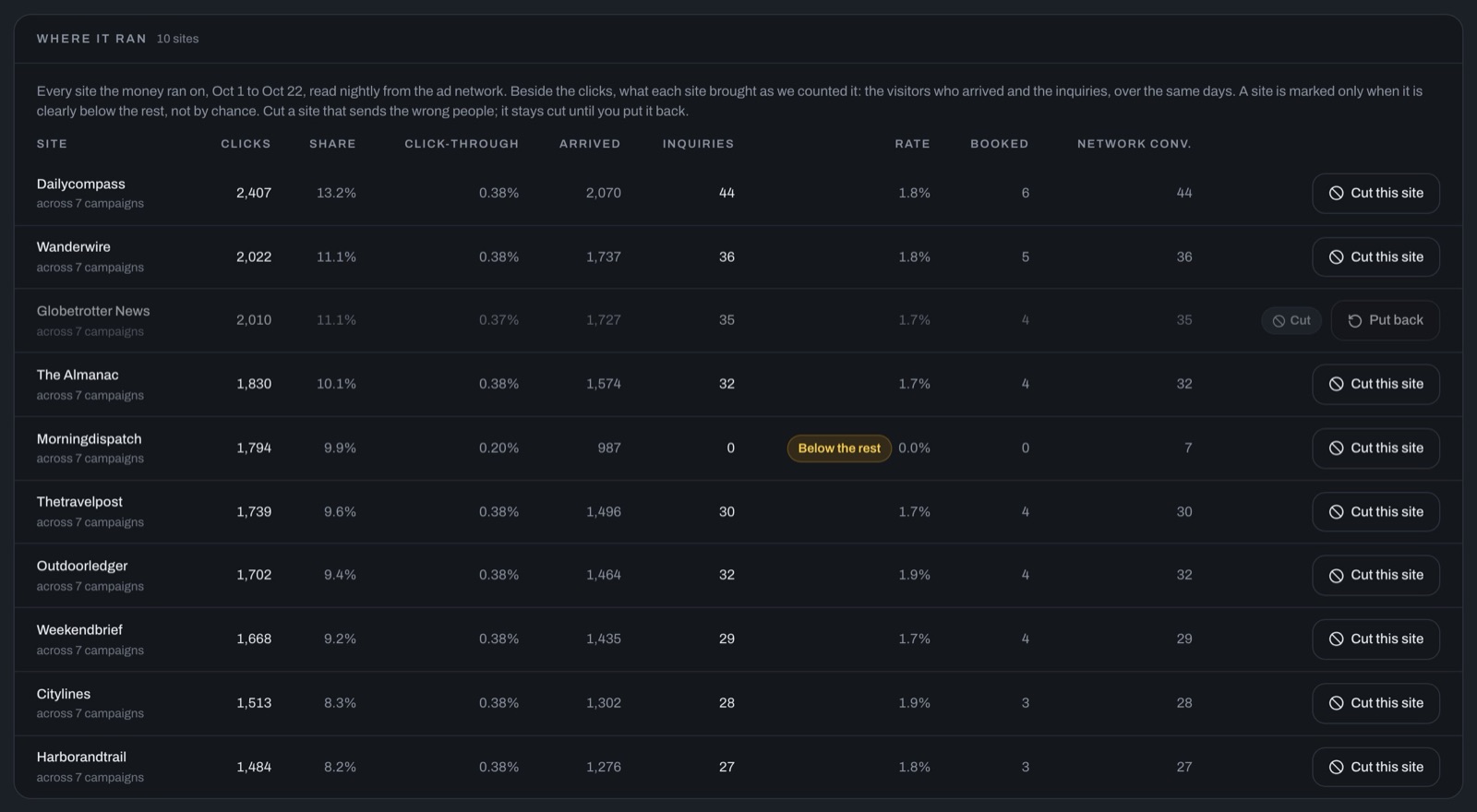
The live report names every site the money ran on, including the ones we cut, with each site's clicks beside what it brought. When a site keeps sending clicks and nothing the campaign is for, the daily check says so, with the numbers. It waits until the difference is clear rather than chance.
You never send us your sales data. On Managed, when an inquiry from a page we built becomes a booking, one tap marks it.
Sources
- The Global Invalid Traffic Report 2026 — Lunio, 2026 (data 1 Aug 2024 to 31 Jul 2025) Checked 23 Oct 2026.
- The 2026 Bad Bot Report is Here — Thales CyberSecurity Products Community (Imperva), 5 May 2026 Checked 23 Oct 2026.
- Invalid Traffic Detection and Filtration Standards Addendum, Update (Final) — Media Rating Council, June 2020 Checked 23 Oct 2026.
- Invalid clicks: Definition — Google Ads Help, undated Checked 23 Oct 2026.
- [UA] The difference between Google Ads Clicks, and Sessions… [Legacy] — Google Analytics Help, undated Checked 23 Oct 2026.
- Performance chapter, Web Almanac 2025 — HTTP Archive, 15 Jan 2026 (July 2025 data) Checked 23 Oct 2026.
- Faster Load Times, Higher Conversions: Yottaa's 2025 Web Performance Index — Yottaa, 28 Jan 2025 Checked 23 Oct 2026.
- How do the rules apply to online advertising? — Information Commissioner's Office, guidance last updated 29 Apr 2026 Checked 23 Oct 2026.
- What are the exceptions? — Information Commissioner's Office, guidance last updated 29 Apr 2026 Checked 23 Oct 2026.
- The Privacy and Electronic Communications (EC Directive) Regulations 2003, Schedule A1 — legislation.gov.uk, in force 5 Feb 2026 Checked 23 Oct 2026.
- Average consent rate in Europe | Didomi 2026 data privacy benchmark — Didomi, 19 Mar 2026 (data 2025) Checked 23 Oct 2026.
- California Consumer Privacy Act (CCPA) — State of California Department of Justice, updated 28 Aug 2026 Checked 23 Oct 2026.
- Universal Opt-Out and the Colorado Privacy Act — Colorado Attorney General, updated 31 Jan 2025 Checked 23 Oct 2026.
- 2026 Ad-blocking report — eyeo, 2026 (GWI data, 2025) Checked 23 Oct 2026.
- About conversion windows — Google Ads Help, undated Checked 23 Oct 2026.
- About "All conversions" — Google Ads Help, undated Checked 23 Oct 2026.
- New Report from Criteo Reveals What's Driving Travel Decisions This Spring and Summer — Skift (sponsored by Criteo), 5 May 2025 Checked 23 Oct 2026.
- Travelers Spend Over 5 Hours Researching Trips On Average – Longer Than Flying From Los Angeles to Washington DC — Hospitality Net (Expedia Group with Luth Research), 26 Jul 2023 Checked 23 Oct 2026.
- Direct Bookings Dive, OTAs Rise — Arival, 26 Jan 2026 Checked 23 Oct 2026.
- Nearly 90% Of Cruisers Intend to Cruise Again, 63% Used a Travel Advisor — Travel Market Report (CLIA data), 17 Apr 2026 Checked 23 Oct 2026.
How we made this: written with AI from the sources above, each opened before it was cited, and read and approved by Russell Goodall. Our editorial standards