Tour operators: when paid ads beat your OTA commission
OTAs took 37% of tour and activity bookings in 2025. One sum shows when a booking from your own ads costs less than the commission.
Russell Goodall, Founder Published 8 min read
The short answer
Paid ads beat your OTA commission when a booking from your ads costs less than the OTA keeps on that booking. Owning the customer is the bonus: if they come back to you direct, their next booking costs neither commission nor clicks.
The one-line test is cost per click ÷ (commission rate × booking value). The answer is the share of your clicks that must book for ads to break even.
OTAs (online travel agencies such as Viator and GetYourGuide) took 37% of tour and activity bookings in 2025, up from 33% in 2024. Operators' own websites fell from 29% to 25%. Both come from Arival's survey of more than 5,000 operators (Arival, 26 Jan 2026; full figures via Travel Daily News, 2 Feb 2026).
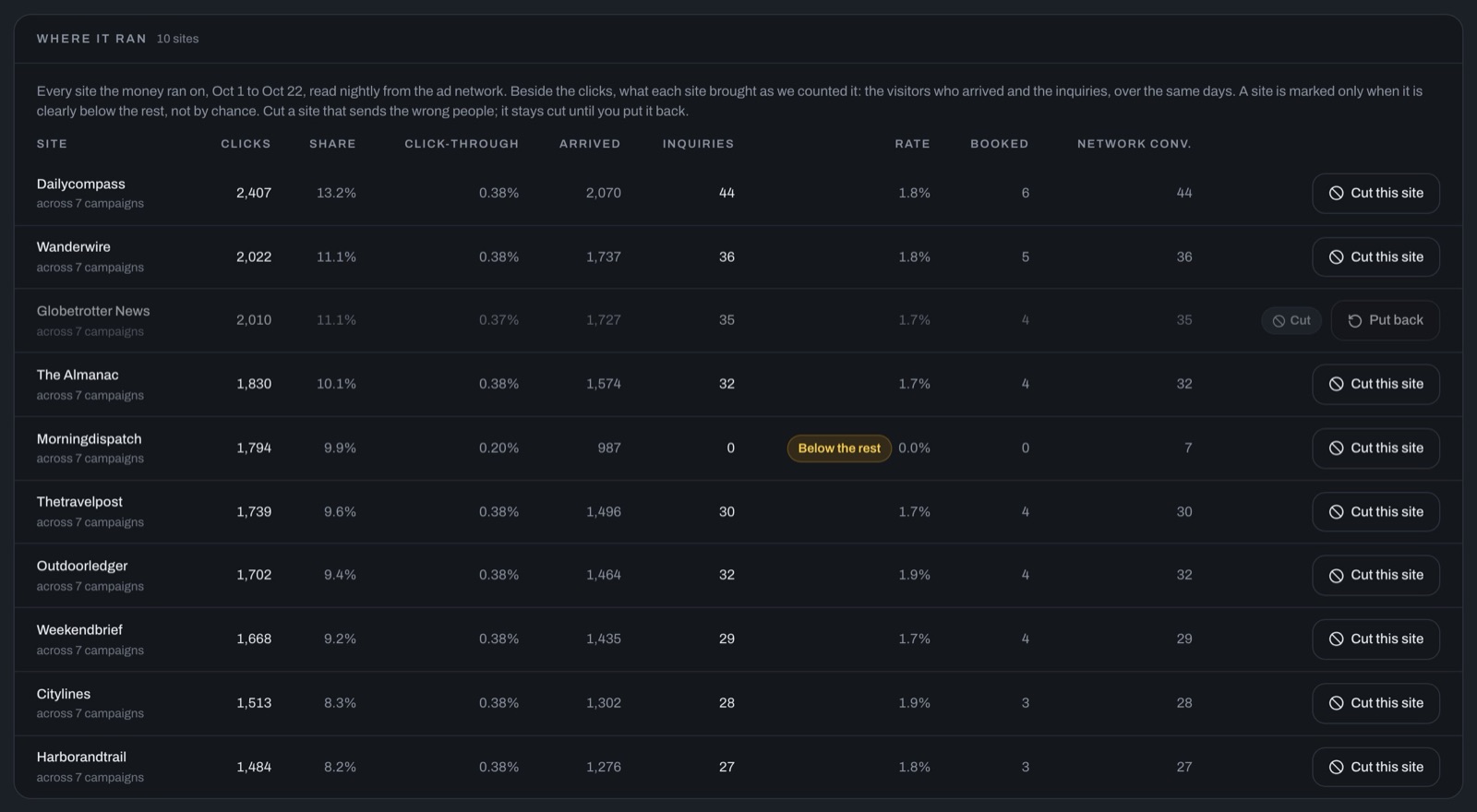
To see a report that puts each site's clicks beside the inquiries it brought, try the Itinex portal demo. It runs on made-up brands with sample numbers, and it asks for your name and company email.
OTA commission in 2026: what each platform says
No platform publishes one rate for every operator. Here is what each says on its own pages, and what operators have reported, with dates.
| Platform | What it says | Source |
|---|---|---|
| Airbnb Experiences | "Typically" a 20% service fee, taken from the host's payout | Airbnb Help Center, undated, opened 23 Oct 2026 |
| GetYourGuide | Rates "may vary depending on your country of operation", shared after sign-up. Charged only on successful bookings | GetYourGuide supplier site, undated, opened 23 Oct 2026 |
| GetYourGuide, as reported | Some operators were told of rises "reaching or surpassing 30%" in June 2025. Some won reversals | Arival, 7 Jul 2025 |
| Viator | A "standard minimum commission rate". Pay a higher rate for more ad placements on Viator | Viator Accelerate, undated, opened 23 Oct 2026 |
| Viator, as reported | One operator put the "basic commission rate" at 27%, "and proper visibility costs even more" | Arival, 7 Jul 2025 |
Two things follow for the sum. Use the rate on your own contract, not a market average. If you pay extra commission to stay visible, use that higher rate.
Rates are also a sore point. An Australian food-tour founder told Arival in July 2025 that 29% is "really high" for his market. A Thailand-based operator added: "If we're going to invest more in marketing, it would be to get more direct sales."
Break-even sum: what one booking costs you each way
This is the framework we use. It puts the two costs of one booking side by side.
- What an OTA booking costs you: commission rate × booking value.
- What an ad booking costs you: cost per click ÷ the share of clicks that book.
- The break-even share: cost per click ÷ (commission rate × booking value).
If more of your clicks book than the break-even share, ads win that booking for less. If fewer book, the OTA is cheaper. Booking value here is the price the traveler pays.
If you sell by inquiry, split the share in two. Multiply the share of clicks that send an inquiry by the share of inquiries that book.
If an agency or managed service runs your ads, add its fee to the ad side, spread across the bookings it brings.
Worked example: made-up numbers
Example only: round numbers chosen to show the sum. They are not benchmarks and not typical results.
| Step | Example |
|---|---|
| Booking value | $200 |
| Commission rate | 25% |
| What the OTA keeps per booking | $50 |
| Your cost per click | $0.50 |
| Break-even share | $0.50 ÷ $50 = 1%, one booking per 100 clicks |
At one booking per 200 clicks, each ad booking costs $100, twice the commission. At two per 100, it costs $25, half the commission. Sold by inquiry, 1% could be 4% of clicks sending an inquiry and a quarter of those inquiries booking.
Don't borrow someone else's average for the share that books. It depends on your trip, your price and your page. The only number worth putting in the sum is your own.
Outside the sum: customers, cash and the OTAs' strengths
The sum compares one booking with one booking. What it leaves out can move the answer either way.
Owning the customer: counts for ads
A traveler who books on your site is your customer. You hold their details and know which ad, site and page brought them. You can email them about the next trip, as long as you follow the email marketing rules. If they rebook direct, that booking costs neither commission nor clicks.
Those rules differ between the UK and the US. In the UK, you normally need consent before sending marketing email to individuals. The exception is the "soft opt-in". It applies when you got their details while selling to them or negotiating a sale, and you market only your similar products.
You must also offer a simple way to opt out at that point and in every later message (ICO, opened 23 Oct 2026). In the US, the CAN-SPAM Act covers all commercial email, not just bulk email. Each message must explain how to opt out, and opt-outs must be honored within 10 business days (FTC, Aug 2023).
Reviews are less of an OTA advantage than they were. Google is now the top place tour takers post reviews. In the US, 32% of travelers post there, against 23% for Tripadvisor and other OTAs (Arival, 21 Jul 2025). A direct customer can review you on Google like anyone else.
Cancellations and payment terms: mostly count for the OTA
- Commission is charged only on bookings that happen. GetYourGuide charges it only on successful bookings, and Airbnb withholds its fee after a completed booking. Clicks cost money whether anyone books or not. So count bookings that went ahead, not bookings made.
- Cash flow cuts both ways. GetYourGuide pays fulfilled bookings in monthly pay runs, and Airbnb releases payouts after the experience. Ads are paid for before anyone books. A direct booking can be paid when the traveler books, if your booking system takes payment upfront.
- On an OTA booking, the platform takes the payment. On a direct booking, the card and booking-system fees are yours, so add them to the ad side.
OTAs still win: last-minute, new markets, reviews
- Last-minute bookings. In Arival's 2025 research, 60% of travelers booked tours and attraction tickets at least three days ahead. The other 40% booked "relatively last minute", and one in five tour bookers bought on the day (Arival, 1 Dec 2025). Same-day buyers are already in the destination, where ads aimed at people planning at home rarely reach them.
- New markets. In GetYourGuide's words, commission pays for "promoting your activities across dozens of marketing channels". Testing a new country through an OTA costs nothing until something sells.
- Reviews where shoppers compare. A busy listing gathers reviews on the page where travelers choose between tours. A new direct page starts with none.
Keep an OTA in the mix for new markets and for dates you need to fill fast. Don't let one platform hold most of your bookings. A change to its ranking or its commission then moves your whole season, and the travelers it sent you are not yours to reach again.
The sum is not a reason to leave the OTAs. It tells you which bookings to stop buying from them.
Paid ads: three limits
- You pay to learn. Clicks are charged while you find out what books, so set a test budget you can afford to spend on learning.
- Digital marketing is getting dearer too. Arival points to "rising digital marketing costs and AI-driven changes in search". Together, it says, they make customer acquisition "both more expensive and harder" (via Travel Daily News, 2 Feb 2026). Rerun the sum each season, not once.
- You need a page and tracking. Without a page built for the offer, and a way to tie each booking to its ad, you can't fill in the sum. Our piece on why ad clicks don't match bookings covers the gap.
Testing before the January peak: UK and US
UK: "Sunshine Saturday", the first Saturday in January (3 January in 2026), is seen as the year's busiest day for booking holidays. The Civil Aviation Authority expected 200,000 more package holiday bookers in January 2026 than a year earlier (TTG, 24 Dec 2025). To have your own number before then, run the test in November and early December.
US: we found no reliable public source for one national booking peak for tours. Use your own records. Find the month your bookings peak, and start at least six weeks before it.
Day tours give answers fast. In Arival's 2025 research, only 17% of tour bookers bought a month or more ahead (Arival, 1 Dec 2025). For multi-day trips booked months out, use inquiries as the early signal and check bookings later.
A test you can read before the peak:
- One product: the trip where the OTA keeps the most per booking.
- One market: a country you already sell to, so a new audience doesn't blur the result.
- A page built for the offer: one trip, its price and dates, and one way to book or ask. Not your homepage.
- Your break-even share, written down before you spend, from your real commission rate.
- Inquiries and bookings counted by site and by ad, not clicks. Only count bookings that go ahead.
- Enough clicks to read: size the test so break-even would mean about ten bookings. At a 1% break-even, that is 1,000 clicks.
- The same product's OTA bookings over the same weeks, to compare against.
Our guide to native advertising for travel brands covers the basics of a first test, from headlines to how long to wait.
Itinex: where it fits
Itinex is a travel advertising platform built on one of the world's largest native advertising networks. Native advertising puts your offer among the stories on news, travel and lifestyle sites, while travelers' plans are taking shape. Three parts of it answer the sum:
- The page between the ad and the booking. It is written from your own website. Two versions run on an even split, and the one that brings more is named once the difference is clear.
- Results by site and ad. With our tag on your page, or on a page we build, each inquiry carries the site and the ad that sent it. Sites that send clicks and nothing else are cut. Inquiry and booking campaigns run on our Managed plan.
- No sales data to hand over. When an inquiry from a page we built becomes a booking, one tap marks it, and the report counts it.
Your own Meta, Google Ads or LinkedIn pixels can ride on the ads and the page, where the reader has agreed to it. Readers who don't book then build audiences in your own ad accounts. We keep none of it.
In the UK, the data regulator (the ICO) says the cookie rule also covers pixels that store or read data on a device (ICO, opened 23 Oct 2026). Using them for online advertising needs the reader's consent (ICO, opened 23 Oct 2026). In California, readers can ask businesses to stop sharing their personal information for ads targeted across websites. Covered businesses must honor a browser's Global Privacy Control setting as that request (California Attorney General, updated 28 Aug 2026).
We don't promise a number before we start.
Sources
- Direct Bookings Dive, OTAs Rise — Arival (Janelle Visser), 26 Jan 2026 Checked 23 Oct 2026.
- OTA bookings hit surge, direct sales slide across global experiences industry — Travel Daily News (Vicky Karantzavelou), 2 Feb 2026 Checked 23 Oct 2026, through a text reader; direct fetches are blocked by Cloudflare.
- GetYourGuide Commission Increasing for Some Operators — Arival (Janelle Visser), 10 Jun 2025, updated 7 Jul 2025 Checked 23 Oct 2026.
- Why does Airbnb charge service fees for services and experiences? — Airbnb Help Center, undated Checked 23 Oct 2026.
- Become a GetYourGuide Supplier (FAQ: "What is the commission fee?" and "How and when do I get paid?") — GetYourGuide, undated Checked 23 Oct 2026.
- Increase your exposure with Viator Accelerate — Viator Supplier Center, undated Checked 23 Oct 2026, through a text reader; direct fetch returned 403.
- How do we comply with the PECR electronic mail marketing rules? — Information Commissioner's Office, undated Checked 23 Oct 2026.
- CAN-SPAM Act: A Compliance Guide for Business — Federal Trade Commission, Aug 2023, edited Jan 2024 Checked 23 Oct 2026.
- Beyond the Stars: A Data-Driven Look at Online Reviews — Arival (Janelle Visser), 21 Jul 2025 Checked 23 Oct 2026, through a text reader.
- Why Travelers Book Experiences in Advance (or Not) — Arival (Douglas Quinby), 1 Dec 2025 Checked 23 Oct 2026, through a text reader.
- Agents told to prepare for 'record peaks demand' with 200,000 more package holiday sales predicted — TTG (Dea Jusufi), 24 Dec 2025 Checked 23 Oct 2026.
- What are storage and access technologies? — Information Commissioner's Office, undated Checked 23 Oct 2026.
- What are the exceptions? (storage and access technologies) — Information Commissioner's Office, undated Checked 23 Oct 2026.
- California Consumer Privacy Act (CCPA) — State of California Department of Justice, Office of the Attorney General, updated 28 Aug 2026 Checked 23 Oct 2026.
How we made this: written with AI from the sources above, each opened before it was cited, and read and approved by Russell Goodall. Our editorial standards