Travel advertorials: what works, with real examples
A travel advertorial is the labeled, article-style page between a native ad and a brand's site. Eight checks, five page styles and real examples.
Russell Goodall, Founder Published 11 min read
The short answer
A travel advertorial is the page between a native ad and a brand's own site. It is written like an article, labeled as an ad at the top, and built to sell one trip.
The ones that work do six things. They pick one angle and answer the ad's headline straight away. They ask for one thing and prove what they claim. They use the brand's own published prices, and they read easily on a phone.
Plain writing has the strongest public evidence. In Unbounce's 2024 report, travel and hospitality landing pages at a US 5th to 7th grade reading level converted at a median 12.8%. That is more than twice any harder level (Unbounce, data July 2023 to July 2024). It covers every traffic source, not only native advertising.
How advertorial pages are built, hosted and tested on Itinex: the platform page.
Definitions: native ad, advertorial, sponsored content, editorial
| Term | What it means |
|---|---|
| Native ad | A paid ad made to fit the page around it, such as a sponsored story in a run of articles (FTC) |
| Advertorial | A paid piece, often written like an article, where the brand controls the words (CAP, 4 Feb 2026) |
| Sponsored content | Used two ways: a brand funds a piece the publisher writes, or a plain synonym for advertorial |
| Editorial | The publisher's own journalism; no brand pays for the words or approves them |
The test is who controls the words. The Guardian uses "Supported by" for funded but editorially independent work. It uses "Paid content" for pieces the advertiser pays for and controls (Guardian, updated March 2024).
UK regulators draw the same line. CAP writes the UK advertising Code, and the ASA enforces it (ASA, opened 26 Oct 2026). CAP's advice says paid content is likely to need disclosing under consumer law. When the brand also has editorial control, the Code applies too (CAP, 23 Mar 2023). The Code has also covered advertising on a company's own website since 2011 (CAP, 26 Feb 2026).
The Itinex advertorial checklist: eight checks before a page goes live
This is our checklist for a travel advertorial. Each check says what to do, and what evidence exists for it. Where we found none, we say so.
1. Angle: one of five page styles
Give each page one angle. Itinex pages come in five styles, and each suits a different sale.
| Style | Fits when | Our sample (made-up brand) |
|---|---|---|
| A story | One trip has a reason to go now, such as a season | Kyoto in November |
| A list | Several reasons add up to one choice | Machu Picchu in a small group |
| A deal | There is a dated offer with a clear total price | Four nights in Cabo |
| A brochure | The trip is long and considered, like a cruise | Norway's fjords brochure |
| A partner page | A tourist board has offers from local businesses | Four autumn extras |
The five samples are for made-up brands, and their forms send nothing. They are kept out of search.
One native advertising network's creative team backs article-style pages. Its 2025 travel playbook lists article-style landing pages, such as top-10 lists and personal travel stories, as a trend that builds credibility (playbook PDF). It also lists soft quizzes and forms. It gives no figures for either.
For a tour operator, we would test a story page first: one trip, told as the traveler will live it, at the operator's own price. For a tourist board, a list page first: several partners' offers in one place, so each reader finds one that fits.
2. Structure: answer the headline first, then build to the action
A working order, top to bottom:
- The page's own "Advertisement" label with the brand's name, then a headline that repeats the ad's promise
- Two or three sentences that answer it
- The reasons, the story or the offer
- Proof
- A short facts box: length, group size, season, what's included
- The action, repeated after the reasons
- Who is behind the page, and how it handles personal details
Keep it short. Unbounce's travel and hospitality data puts the best range at 200 to 750 words, and suggests aiming for about 400 (Unbounce).
3. Headline-to-page match: same promise, same words
The reader clicked a headline. The first screen of the page should deliver that promise, in the same words, with the same picture. If it opens on something else, the reader has to hunt for what they came for.
We found no public travel study that measures this on its own. It is our rule, not a benchmark.
4. One action: ask for one thing
Each page asks for one thing and repeats it after the reasons. A phone number is the fallback for readers who would rather talk. Our samples show one action per style:
- The story asks about dates, and a trip leader replies by email.
- The list offers a call or a WhatsApp message.
- The deal sends readers to check dates and book on the hotel's own site.
- The brochure posts a free printed brochure.
A partner page is the exception. Each local business gets its own offer link, plus one email sign-up for the area. No public travel study isolates this check either. Our reason is simple: every extra choice is a place to stop.
5. Proof: real, sourced and the brand's own
Use proof the brand can stand behind. That means real reviews with their source, ratings, awards, trade memberships and the guide's own experience.
The evidence on reviews comes from retail, not travel. Northwestern University's Spiegel Research Center studied it in 2017. A product with five reviews had a 270% greater purchase likelihood than one with none (Spiegel Research Center). The effect was larger for higher-priced products. Purchase likelihood peaked at ratings of 4.0 to 4.7, then fell toward 5.0.
Never invent a reviewer or a test, and never dress an ad as an independent review. On 21 October 2026 the ASA ruled against a page presented as an independent product review. It carried bylines and a "How we tested" section. But the site owner also owned the top-ranked product, and had published the page to promote it (ASA, 21 Oct 2026).
Fake reviews are banned in both markets:
- UK: since 6 April 2025, submitting or commissioning a fake consumer review is always unfair. The same applies to a review that hides that it was paid for or rewarded (legislation.gov.uk).
- US: the FTC's rule on consumer reviews and testimonials, in force since 21 October 2024, bans fake or false ones. It also bans a business falsely claiming that a site it controls gives independent reviews in its own product category (FTC, Nov 2024).
6. Prices: the brand's own published prices, in full
Every price, date and number on the page should be one the brand already publishes. If the page shows one price and the booking page another, the reader finds out at checkout.
- UK: quoted prices must include all non-optional taxes, duties, fees and charges that apply to all or most buyers. That is CAP Code rule 3.18 (ASA, April 2026). Consumer law goes the same way for mandatory local charges, such as resort fees, and taxes. The CMA says they go in the total price wherever you can reasonably work them out (CMA, 7 Jan 2026).
- US: since 12 May 2025, an ad for short-term lodging that shows a price must show the total price. Mandatory fees, such as resort fees, go in it. Government taxes may be shown later, before payment (FTC, May 2025).
Our sample deal page shows the hotel case under the US rule. Its price includes the nightly resort fee, and it says local taxes are added and shown before payment. A page for UK buyers would normally put those taxes in the price as well.
7. Mobile reading: short, fast and easy to tap
Write for the phone first. In Unbounce's travel and hospitality data, mobile brought nearly four times as much traffic as desktop (Unbounce).
Speed counts too. Google's guidance is that a page's largest image or text block should appear within 2.5 seconds. That should hold for at least three in four visits (web.dev, updated September 2025).
In practice:
- Short paragraphs, and the key facts in a box
- A phone number that calls when tapped
- Forms of a few taps; our sample story page uses four short steps
8. Label: at the top, in plain words
Put a label such as "Advertisement" above the headline, with the brand's name. The label on the native ad, on the publisher's site, does not cover your own page. The page needs its own label. The rules are below.
Real examples: three public travel advertorials
These three sit on publishers' own sites, so anyone can open them. Read them for the craft. We describe them; we don't reproduce them.
The Guardian, "Postcards From The Piste", September 2026, paid for by Sunweb, a ski holiday company. One paid series runs four angles:
- A list of five French resorts, each matched to a type of skier (list)
- A first-person story of a mother learning to ski in her 40s (story)
- A quiz that matches readers to a resort (quiz)
- A guide to where to save and where to spend (guide)
The list links each resort and place to stay to the brand's own pages. The story holds back: one link midway, and the brand's name in the last line. Each page opens with a "Paid content" label. A "Paid for by" credit with the brand's logo sits near the byline.
The Guardian, "Every Stop Is A Story", August 2026, paid for by Govia Thameslink Railway. A writer takes a day trip by Great Northern train to Royston and King's Lynn (day trip). The piece names the local shops and cafes visited. The rail company appears in the first paragraph, as the way to get there.
AFAR, for Visit Reno Tahoe, 15 October 2026. A US travel magazine's piece for a tourist board, written as a local's guide for families (AFAR). A restaurant co-owner from a four-generation local family picks places to eat, parks, winter outings, hotels and events.
The piece links to the tourism board's own pages and straight to the places named. The header reads "Sponsored Content", and the tourism board is named beside the date.
What the three share: one angle per page, a named voice, the brand named at the top, and specific places instead of general praise.
Labeling: the UK and US basics
This is a summary, not legal advice. Check your own pages with a qualified adviser.
| UK | US | |
|---|---|---|
| The rule | Ads must be "obviously identifiable" (CAP Code rule 2.1). Advertorials must be made clear as ads, for example headed "advertisement feature" (rule 2.4) | An ad must not mislead people about being an ad. Where a native ad could, it needs a clear and prominent disclosure (FTC policy statement and guide, December 2015) |
| Words to use | "Ad", "Advert", "Advertising", "Advertisement" or "Ad Feature" | "Ad", "Advertisement", "Paid Advertisement" or "Sponsored Advertising Content" |
| Words to avoid | "Sponsored", which CAP's advice calls "open to varied interpretation" | "Promoted" or "Promoted Stories" |
| Where | Upfront, in a prominent and easily noticed place | In front of or above the headline; on the page the ad opens too, unless that page is obviously an ad |
Sources: CAP Code section 2; CAP advice, March 2023; FTC policy statement, 22 December 2015; FTC guide, December 2015.
UK. Rules 2.3 and 2.4 now say they reflect practices banned by the Digital Markets, Competition and Consumers Act 2024 (CAP, opened 26 Oct 2026). Its Schedule 20 lists practices that are always unfair, in force since 6 April 2025. They include paid promotion inside editorial content without making that clear, and falsely implying that a trader is not acting for its business (legislation.gov.uk).
UK. The newest lesson is the ASA ruling of 21 October 2026. A paid social ad was labeled "Ad". The page it opened was on the marketer's own website, but looked like an independent review. Its only advertorial notice sat in smaller text in the footer.
The ASA said readers would take the "Ad" label to mean only that the social ad was paid for. It did not tell them the review page was marketing too. The footer notice came too late, because readers were unlikely to see it until they had engaged. The ad and the page both broke CAP rules 2.1, 2.3 and 2.4 (ASA, 21 Oct 2026). The product was dishwasher tablets, but the page type is the same.
US. The FTC says the page a native ad opens needs its own clear label near the headline, unless the page is obviously an ad. Readers can reach that page in other ways (FTC, Dec 2015).
The FTC also says a logo or brand name on its own is not likely to be enough. Readers may take "Sponsored by [brand]" to mean the brand funded the piece but did not create it. Disclosures must be clear on every device (FTC, Dec 2015).
For a travel advertorial page, that comes to four habits:
- Put the label above the headline, in words like "Advertisement by [brand]".
- Repeat it near the action, so readers who scroll past the top still see it. Our story, list and partner samples do.
- Name the brand. Never dress the page as an independent review or a newspaper.
- Check that the label is easy to read on a phone.
Limits: three things an advertorial can't do
- It can't fix a weak offer. If the trip, price or dates don't suit the reader, a better page only makes that clear sooner. Fix the offer first.
- It adds a step. Some readers would book straight from the brand's own page. Test the advertorial against sending the ad straight there, and keep whichever brings more.
- There is no native travel benchmark to judge it by. We found none published for advertorial pages, as of October 2026. The nearest public figure is Unbounce's 4.8% median for travel and hospitality landing pages from every traffic source (Unbounce). Treat it as context, not a target. Your own split test is the measure.
Where Itinex fits
Advertorial pages on Itinex are written from the brand's own website. Every price, date and number on the page is one the brand already publishes. Pages come in the five styles above, and we host them.
Two versions run side by side on an even split of the traffic. The one that brings more is named once the difference is clear. Then a new angle is tested against the winner.
On Self-serve, you build pages yourself with the AI page builder, and we check each one before it goes live. On Managed, your account manager writes and tests them. Every starting price is on the pricing page.
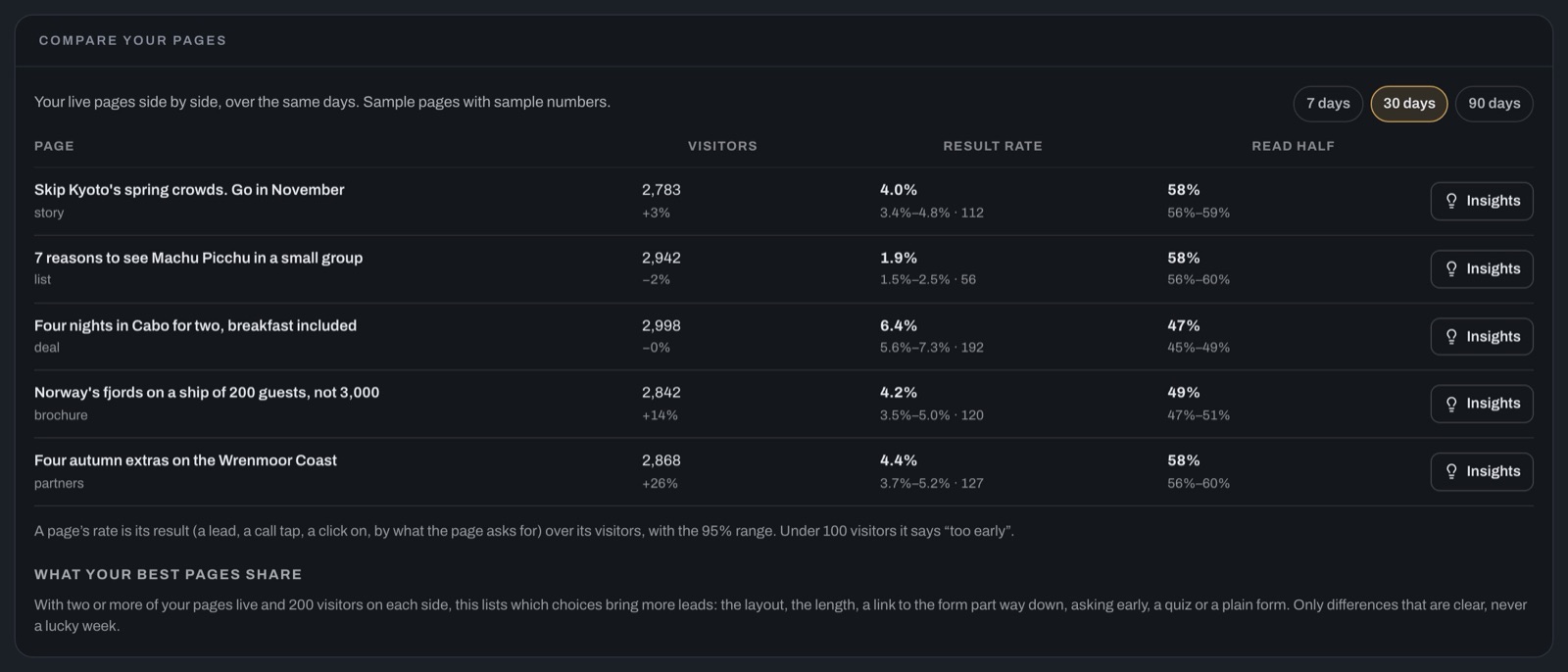
Next step: see the Pages section in the demo portal. It runs on made-up brands with sample numbers, and asks for your name and company email. Try the demo at itinexads.com/demo
Sources
- Conversion Benchmark Report: Travel and hospitality — Unbounce, 2024 report (page updated 25 Feb 2026; data 23 Jul 2023 to 23 Jul 2024) Checked 23 Oct 2026.
- Conversion Benchmark Report: Methodology — Unbounce, 2024 Checked 23 Oct 2026.
- Native Advertising: A Guide for Businesses — Federal Trade Commission, December 2015 Checked 23 Oct 2026.
- Enforcement Policy Statement on Deceptively Formatted Advertisements — Federal Trade Commission, 22 Dec 2015 Checked 26 Oct 2026.
- CAP Code, Section 02: Recognition of marketing communications (Edition 12) — ASA and CAP Checked 23 Oct 2026.
- Recognising ads: Advertisement features — ASA and CAP, 23 Mar 2023 Checked 23 Oct 2026.
- Remit: Advertisement features — ASA and CAP (CAP Executive advice), 4 Feb 2026 Checked 26 Oct 2026.
- Remit: Own websites — ASA and CAP (CAP Executive advice), 26 Feb 2026 Checked 26 Oct 2026.
- About the ASA and CAP — ASA and CAP, undated Checked 26 Oct 2026.
- Recognising ads: Native advertising — ASA and CAP, 23 Oct 2026 Checked 23 Oct 2026; supports the ruling summary, not cited in the body.
- Digital Markets, Competition and Consumers Act 2024, Schedule 20: Commercial practices which are in all circumstances considered unfair — legislation.gov.uk Checked 23 Oct 2026.
- ASA Ruling on Cara Capsules Ltd t/a Home + Health — ASA, 21 Oct 2026 Checked 23 Oct 2026.
- Travel marketing: Pricing — ASA and CAP, 30 Apr 2026 Checked 23 Oct 2026.
- Rule on Unfair or Deceptive Fees: Frequently Asked Questions — Federal Trade Commission, May 2025 Checked 23 Oct 2026.
- Providing clear and accurate information about prices: summary (CMA209) — Competition and Markets Authority, updated 7 Jan 2026 Checked 26 Oct 2026.
- Consumer Reviews and Testimonials Rule: Questions and Answers — Federal Trade Commission, Nov 2024 Checked 26 Oct 2026.
- Largest Contentful Paint (LCP) — web.dev (Google), updated 4 Sep 2025 Checked 23 Oct 2026.
- How Online Reviews Influence Sales — Medill Spiegel Research Center, Northwestern University, first published 2017 Checked 23 Oct 2026.
- Creative Playbook – Travel // 2025 — Taboola (Realize), 2025 (file path dated July 2025) Checked 23 Oct 2026.
- Content funding on the Guardian — Guardian News & Media, updated 8 Mar 2024 (first published 25 Jan 2016) Checked 23 Oct 2026.
- Five hidden gem ski resorts in France, perfect for everyone from couples to families — The Guardian (Guardian Labs, paid content), 1 Sep 2026 Checked 23 Oct 2026.
- 'Learning to ski has empowered me': how one mum overcame her fear of the slopes in her 40s — The Guardian (Guardian Labs, paid content), 2 Sep 2026 Checked 23 Oct 2026.
- Super skier or more après? Take our quiz to find your perfect resort — The Guardian (Guardian Labs, paid content), 1 Sep 2026 Checked 23 Oct 2026; title and label checked only.
- Where to save and when to splurge on the slopes, according to a frequent skier — The Guardian (Guardian Labs, paid content), 1 Sep 2026 Checked 23 Oct 2026; title and label checked only.
- Mindfulness and medieval wonders: a rail adventure to Royston and King's Lynn — The Guardian (Guardian Labs, paid content), 11 Aug 2026 Checked 23 Oct 2026.
- Four Generations Deep, This Reno Family Knows Where to Take the Kids — AFAR (Sponsored Content, Visit Reno Tahoe), 15 Oct 2026 Checked 23 Oct 2026.
- Itinex sample advertorial pages (made-up brands) — Itinex: /l/sample-story, /l/sample-list, /l/sample-deal, /l/sample-brochure, /l/sample-partners. (all five opened 23 Oct 2026; each returns 200 and carries "noindex, nofollow")
- Itinex llms.txt and /platform (product claims) — Itinex Checked 23 Oct 2026.
How we made this: written with AI from the sources above, each opened before it was cited, and read and approved by Russell Goodall. Our editorial standards