Cruise wave season: start paid media in October, not January
Carnival had about two-thirds of 2026 booked before wave season began in January. A month-by-month calendar for paid media, and how to measure it.
Russell Goodall, Founder Published 12 min read
The short answer
Start cruise paid media in October, and treat wave season (roughly January to March) as the harvest, not the launch. On 19 December 2025, before wave season opened, Carnival Corporation said it already had about two-thirds of 2026 booked (Carnival, 19 Dec 2025).
Three facts set the timing:
- Most of the year sells early. Royal Caribbean Group had about two-thirds of 2026 booked by 29 January 2026. It called that "within historical ranges" (Royal Caribbean Group, 29 Jan 2026).
- The lines' own offers start in late November. Carnival reported strong bookings "from Black Friday through Cyber Monday" and called them "a favorable indicator for wave season" (Carnival, 19 Dec 2025).
- Most cruisers book through a travel advisor. In CLIA's December 2025 survey, 63% of people who had cruised in the past 12 months used one (CLIA, Apr 2026).
Our reading: your ads have to reach people while the plan is still forming. By January, many have booked, and many more arrive at an advisor with a shortlist. Our month-by-month calendar is below.
A campaign that starts cold in January has no readers to return to. Everyone it reaches meets the brand for the first time, in the weeks when the most bookings are made. Start in October, and the people who read the brochure page in the autumn are there to reach again when the offers launch.
See a sample brochure request page, built for a made-up cruise line
Wave season dates: January to March, with offers from late November
Wave season is the cruise industry's peak period for bookings and offers. Trade coverage calls it "the critical January-through-March window" (Nautical Flock, 26 Feb 2026).
The 2026 season was strong for the big lines and steadier underneath:
- Royal Caribbean Group: "the highest seven booking weeks in the company's history" (Royal Caribbean Group, 29 Jan 2026).
- MSC Cruises: its best ever start to January, with 2026 bookings up 10% on the year before (MSC Cruises, 20 Jan 2026).
- The wider market: Cleveland Research Company's wave season survey found booked revenue up 4% and booking volume up 1.5%. It found bookings positive but "not quite as 'optimistic' as last year" (TravelPulse, 23 Jan 2026).
The start has moved earlier. Royal Caribbean's record weeks included its Cyber sales, and Carnival read Black Friday as a signal for the season. The first offers now land before Christmas.
Booking windows: most of next year is sold before wave season opens
Cruises are booked far ahead. Cleveland Research found ocean cruises are planned about eight months in advance, and river cruises about 11 months (TravelPulse, 23 Jan 2026).
The lines' own figures show how much sells early:
| Company | Date | Share of 2026 already booked |
|---|---|---|
| Carnival Corporation | 19 Dec 2025 | About two-thirds |
| Royal Caribbean Group | 29 Jan 2026 | About two-thirds |
| Carnival Corporation | 27 Mar 2026 | Nearly 85% |
Sources: Carnival, 19 Dec 2025; Royal Caribbean Group, 29 Jan 2026; Carnival, 27 Mar 2026.
So wave season fills the last part of this year and opens the next. In March, Carnival also reported demand reaching "well into 2028 sailings" (Carnival, 27 Mar 2026).
The autumn is a booking season in its own right. In the three months to 19 December 2025, Carnival reported record booking volumes for 2026 and 2027 sailings (Carnival, 19 Dec 2025). Carnival Cruise Line's international sales director told TTG it sees "some of our biggest months in September and October" (TTG, 11 Feb 2025).
What this means: an audience you start in October meets people while they plan, and stays with them into January. One you start in January meets them after most of the year is sold.
Travel advisors: 63% of cruisers book through one
The advisor share barely moves. In every CLIA survey since July 2022, between 60% and 66% of recent cruisers used a travel advisor. The December 2025 figure was 63.4% (CLIA, Apr 2026). The survey covers nine countries, including the UK and the US, with 500 responses from each.
Advisors shape the choice, not only the paperwork:
- 79% of cruise travelers say travel agents have "a meaningful impact" on their decision to cruise (CLIA, May 2025).
- Asked what influences the decision, 40% named friends and family as a significant influence. 30% named travel advisors, and 23% named marketing and advertising (CLIA surveys, July 2022 to March 2024, in the same report).
Our reading: in cruise, advertising seldom works alone. For most buyers, its job is to put your line, ship and itinerary on the shortlist before they call an advisor. So the first result you can count is a request, not a booking.
First-time and repeat cruisers: two audiences, two messages
New cruisers are a growing share. 31% of cruisers in the two years to December 2024 were new to cruising, up from 24% in 2019 (CLIA, May 2025). And 75.6% of people who have never cruised say they are open to a first cruise (CLIA, Apr 2026).
Repeat cruisers are loyal and frequent. Nearly 90% of cruisers intend to cruise again, and 27.7% of them take two or more cruises a year (CLIA, Apr 2026).
Our reading of what each group needs:
- First-timers need the format explained: what is included, what a cabin is like, why this ship. A story or a brochure page does that before the sale.
- Repeat cruisers respond to news: new dates, new ships, new itineraries. Cunard's UK sales director told TTG its peak booking periods are its two program launches. One falls between March and May, the other in September or October (TTG, 11 Feb 2025).
Where people live matters too. In CLIA's December 2025 survey, 52% of recent cruisers drove to the port they sailed from, and 35% flew (CLIA, Apr 2026). So the area around a departure port, and the airports that feed it, is a real audience.
The wave season calendar: what to do each month
This is our framework for a cruise line or cruise seller. It works back from the January peak.
| When | What to do | What to measure |
|---|---|---|
| September | Set the budget and the offer. Build the brochure page. Set up codes and CRM fields. | A test request reaches your CRM |
| October | Start audiences near the port and among people searching the itinerary. | Cost per brochure request |
| November | Keep running through Black Friday and Cyber Monday, when the lines' offers start. | Requests by audience and by site |
| December | Hold spend steady. In the UK, get ready for the first Saturday of January. | Past readers you can show the offer to again |
| January to March | Peak spend, on past requesters and new audiences. | Brochure and quote requests; first matched bookings |
| April onward | Match bookings to requests. Plan next autumn. | Request-to-booking rate; cost per booking |
Starting in January still reaches wave season buyers. It misses the people who formed their shortlist in the autumn, and it has no past readers to return to.
We want the brochure page live by mid-October, because that is when the plan for next year starts to form. It gives the page three months to gather readers before the wave season offers launch.
Brochure and quote requests: the result to count while the campaign runs
A booking may come much later, often through an advisor, where you cannot see it. A brochure or quote request arrives the same day, with a name you can follow.
Count two kinds of request:
- Brochure request: a softer signal. The reader wants to know more.
- Quote request: a stronger signal. The reader has dates or a cabin in mind.
Add one question about timing to the form. The sample page linked above opens its form with "What are you planning?" Its three answers are a trip in the next few months, something later this year or next, or just ideas. That answer sorts requests by intent before anyone calls.
The sum that matters: cost per booking equals cost per request divided by the share of requests that book. Here is an example, not a benchmark. If $5,000 of clicks brings 250 brochure requests, each request costs $20. If 1 in 25 of those requests books, each booking costs $500.
Measuring leads that close through advisors: three methods
None of these sees every booking. Used together, they give you a floor: the bookings you can prove, not every booking the campaign helped.
| Method | What it catches | Main limit |
|---|---|---|
| Unique codes | Bookings where the code is quoted | Codes get forgotten or not entered |
| CRM matching | Most bookings in the requester's name | Misses bookings made in another name |
| Advisor attribution | Which agencies close your leads | Relies on agencies and slow reporting |
Unique codes: give each campaign its own offer code, sent with the brochure, for the customer or advisor to quote at booking. Tie it to a small benefit, such as onboard credit, so there is a reason to mention it.
CRM matching: match requesters' emails and names against your passenger records for the next 12 months. A passenger name sits on every booking, including advisor bookings, so this catches the most. It runs in your own systems. Check that your privacy notice covers this use.
In the UK, this matching needs a lawful basis under UK GDPR. If it is a new purpose, it must be compatible with the original one. You must also update your privacy information and tell people before you start (ICO, updated 23 Mar 2026). In California, covered businesses must give a notice when or before they collect personal data, listing what they use it for (California Attorney General, updated 28 Aug 2026).
Advisor attribution: your trade bookings carry the agency's ID. When a requester books through an agency, note which one. Over a season, that shows which agencies close your ad leads, and where to send the next ones.
A cross-check, if you have the volume: run the campaign in some regions, hold others back, and compare bookings by region. It counts bookings that no code or match catches, but it needs enough bookings in each region to read.
Three limits to plan for:
- The full answer arrives late. Bookings can come months after a request, so an October campaign may not show its booking count until spring. Until then, judge it on cost per request and the timing answers, and agree that with whoever owns the budget.
- Matched bookings are a minimum. Some people book in another name, or through an agency that never reports.
- Cheap requests are not always good requests. Check the request-to-booking rate before you scale.
UK and US: what differs
The season runs January to March in both markets. What differs is the size of the market and what wave season competes with.
| UK | US | |
|---|---|---|
| Cruise passengers, 2025 | 2.5m (UK and Ireland, up 5.7%) | 20.6m (up 7.5%) |
| Wave season | January to March, inside the January holiday peak | January to March |
| Advisor share | Not published by country; CLIA's 63% pools nine countries | Not published by country |
| Price rules | Total price, including mandatory charges | FTC fees rule covers lodging and tickets; DOT rule covers fly-cruise packages; state laws vary |
UK: wave season sits inside the biggest booking month for all trips. The Civil Aviation Authority forecast 200,000 more people booking package holidays in January 2026 than the 4.3m of January 2025. Agents expected the peak on "Sunshine Saturday", 3 January (TTG, 24 Dec 2025).
P&O Cruises told TTG the wave period is "the opportunity to appeal to people that are in the holiday market" (TTG, 11 Feb 2025). Sailings from UK ports are growing: MSC reported summer 2026 departures from the UK up 24% (MSC Cruises, 20 Jan 2026).
US: the market is about eight times the size of the UK and Ireland (20.6m against 2.5m passengers in 2025). US cruisers also dominate the Caribbean: they made up 86.7% of its cruise passengers in 2025 (CLIA, Apr 2026).
Prices in cruise ads: the total-price rules
This is a short summary, not legal advice. Have a qualified person check any ad that shows a price before it runs.
UK: the Competition and Markets Authority (CMA) enforces the Digital Markets, Competition and Consumers Act 2024. Its guidance says the total price "should normally include any unavoidable or 'mandatory' charges". Showing them separately "will not normally be enough" (CMA, updated 7 Jan 2026).
A "from" price is allowed if it includes all mandatory charges and does not mislead about what the price covers (CMA, updated 7 Jan 2026). The full guidance says local taxes and other unavoidable charges due at ports are mandatory charges (CMA, 18 Nov 2025).
The CMA's first fine for breaking consumer law under its new powers was £4.2m, in April 2026. The AA's driving schools had left a mandatory £3 booking fee out of the upfront price (CMA, 15 Apr 2026).
In a 2020 ruling, the Advertising Standards Authority (ASA) rejected a complaint about cruise prices that left out a daily service charge. Passengers were told about it before booking and could remove it, and enough did to show it was optional (ASA, 26 Feb 2020).
That ruling came before the 2024 Act, though the ASA still cites it (ASA, 30 Apr 2026). The CMA says showing a charge separately, or calling it an extra service, does not make it optional (CMA, 18 Nov 2025).
US: the Federal Trade Commission's fees rule, in force since 12 May 2025, covers live-event tickets and short-term lodging. Neither the rule nor the FTC's guidance on it mentions cruises (FTC, May 2025; 16 CFR 464, as of 22 Oct 2026). So whether a cruise cabin counts as lodging under it is a question for a lawyer. The rule does cover hotel stays sold by travel agents, so a hotel night sold with a cruise may be in scope.
A separate federal rule reaches fly-cruise packages. The Department of Transportation's price rule covers "a combination of air transportation and ground or cruise accommodations". It applies to airlines and ticket agents. When they advertise a price for such a package, it must be the entire price, government taxes included (14 CFR 399.84, as of 22 Oct 2026).
State law can go further. California's SB 478 has applied since 1 July 2024. It requires advertised prices for most consumer goods and services to include all mandatory fees. Taxes or fees that a government imposes on the transaction can be left out (California Attorney General, opened 26 Oct 2026).
Ask a lawyer how port charges, taxes and automatic gratuities should appear in your headline fares in each market. In the US, ask too whether a port charge counts as a government fee.
Where Itinex fits
Itinex is a travel advertising platform, built on one of the world's largest native advertising networks. For wave season, these are the parts that matter to a cruise line or cruise seller:
- Audiences near the port. We build audiences from what people search, the newsletters they received from brands like yours, and where they live. That includes the area around the port and its fly-cruise gateways.
- Brochure pages. Advertorial pages, including a brochure style, written from your own website. Two versions run on an even split of the traffic.
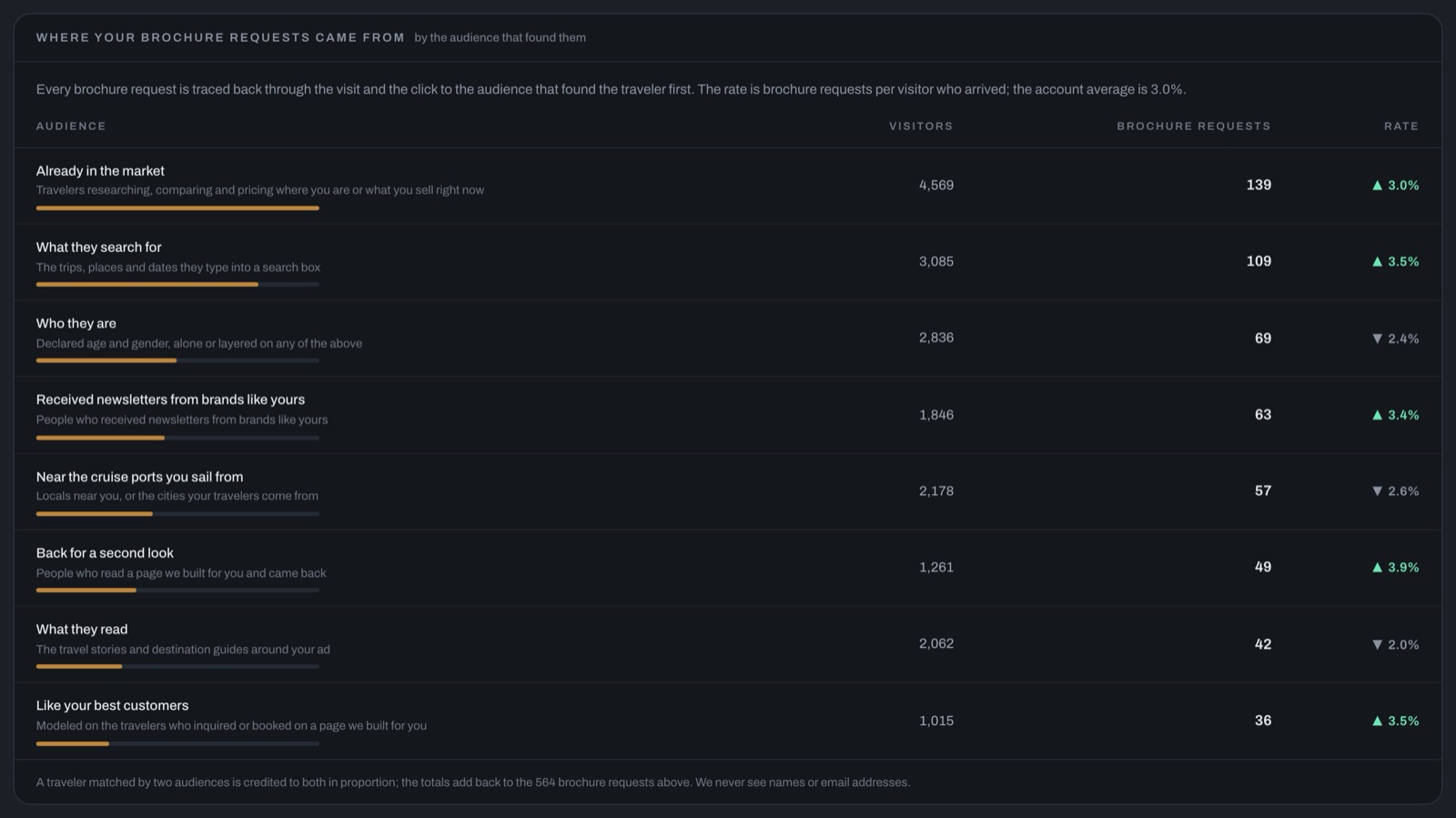
- Requests traced to their source. Every request through a page we build, or our tag on yours, carries the site and the ad that sent it. When a request from a page we built becomes a booking, one tap marks it.
- A live report in the portal, with a link you can send to whoever owns the budget.
- Your own retargeting audiences. Your Meta, Google Ads, LinkedIn or TikTok pixels ride on the ads and on the page, with the reader's consent where it is required. In the UK and Europe, the ad pixels are held back without consent, and the page asks first. October's readers build as audiences in your own ad accounts. We keep none of it.
In the UK, the data regulator (the ICO) says the cookie rules cover tracking pixels that store or read data on a device (ICO, opened 26 Oct 2026). Using them for online advertising needs consent (ICO, opened 26 Oct 2026). In California, people can opt out of their personal information being shared for ads targeted across websites. Covered businesses must honor a browser's Global Privacy Control signal as that request (California Attorney General, updated 28 Aug 2026).
Campaigns built for inquiries and bookings are on our Managed plan. A campaign goes live within four working days of being sent, so an October start is still open in late September. Every starting price is on the pricing page. New to native advertising? Start with what it is and how a first test works.
Sources
- Carnival Corporation & plc fourth quarter 2025 earnings release (SEC Form 8-K, exhibit 99.1) — Carnival Corporation & plc, 19 Dec 2025 Checked 23 Oct 2026.
- Carnival Corporation & plc achieves record first quarter operating results and record bookings (SEC Form 8-K, exhibit 99.1) — Carnival Corporation & plc, 27 Mar 2026 Checked 23 Oct 2026.
- Royal Caribbean Group reports 2025 results, issues 2026 guidance (SEC Form 8-K, exhibit 99.1) — Royal Caribbean Group, 29 Jan 2026 Checked 23 Oct 2026.
- 2026 State of the Cruise Industry (presentation; includes CLIA Cruise SPI, December 2025) — Cruise Lines International Association, 14–15 Apr 2026 Checked 23 Oct 2026.
- State of the Cruise Industry Report 2025 — Cruise Lines International Association, May 2025 Checked 23 Oct 2026.
- Wave Season 2026: Positive Growth, But Less Optimism for the Year (reporting Cleveland Research Company) — TravelPulse, Lacey Pfalz, 23 Jan 2026 Checked 23 Oct 2026, archived copy.
- Royal Caribbean Reports Best Booking Weeks in Company History During Wave Season — Nautical Flock, 26 Feb 2026 Checked 23 Oct 2026.
- MSC Cruises reports best ever start to January — MSC Cruises press area, 20 Jan 2026 Checked 23 Oct 2026.
- Five top trends cruise agents need to know – from Carnival UK's sales chiefs — TTG, Sophie Griffiths, 11 Feb 2025 Checked 23 Oct 2026.
- Agents told to prepare for 'record peaks demand' with 200,000 more package holiday sales predicted — TTG, Dea Jusufi, 24 Dec 2025 Checked 23 Oct 2026.
- Providing clear and accurate information about prices: summary (CMA209) — Competition and Markets Authority, GOV.UK, updated 7 Jan 2026 Checked 23 Oct 2026.
- Unfair commercial practices: price transparency (CMA209), full guidance — Competition and Markets Authority, 18 Nov 2025 Checked 26 Oct 2026.
- CMA orders the AA and BSM driving schools to refund learner drivers over drip pricing — Competition and Markets Authority, GOV.UK, 15 Apr 2026 Checked 26 Oct 2026.
- Travel marketing: Pricing — Advertising Standards Authority, 30 Apr 2026 Checked 23 Oct 2026.
- ASA Ruling on Sunshine Cruise Holidays Ltd (not upheld) — Advertising Standards Authority, 26 Feb 2020 Checked 26 Oct 2026.
- Rule on Unfair or Deceptive Fees: Frequently Asked Questions — Federal Trade Commission, May 2025 Checked 23 Oct 2026.
- Rule on Unfair or Deceptive Fees, 16 CFR Part 464 — Federal Trade Commission, in force 12 May 2025; eCFR text up to date as of 22 Oct 2026 Checked 26 Oct 2026, through the eCFR API.
- Price advertising and opt-out provisions, 14 CFR 399.84 — US Department of Transportation, last amended 2 Jul 2026; eCFR text up to date as of 22 Oct 2026 Checked 26 Oct 2026, through the eCFR API.
- SB 478 – Hidden Fees — California Department of Justice, Office of the Attorney General, undated page (law in force 1 Jul 2024) Checked 23 Oct 2026.
- Principle (b): Purpose limitation — Information Commissioner's Office, updated 23 Mar 2026 Checked 26 Oct 2026.
- What are storage and access technologies? — Information Commissioner's Office, guidance last updated 29 Apr 2026 Checked 26 Oct 2026.
- What are the exceptions? (storage and access technologies) — Information Commissioner's Office, guidance last updated 29 Apr 2026 Checked 26 Oct 2026.
- California Consumer Privacy Act (CCPA) — State of California Department of Justice, Office of the Attorney General, updated 28 Aug 2026 Checked 26 Oct 2026.
- Sample brochure page for a made-up cruise line — Itinex Checked 23 Oct 2026.
How we made this: written with AI from the sources above, each opened before it was cited, and read and approved by Russell Goodall. Our editorial standards