OTA sponsored listings or native advertising for hotels?
A cost-per-booking table and a three-question test show hotels when to fund OTA sponsored listings or native advertising, and who keeps the guest.
Russell Goodall, Founder Published 9 min read
The short answer
Fund OTA sponsored listings first only for dates you must fill in the next few weeks. Fund native advertising first for direct bookings and guests you can reach again. Each sponsored-listing booking still pays the OTA's commission: at Booking.com, from about 15% to a common 18–22% with visibility programs (Tribii, July 2026).
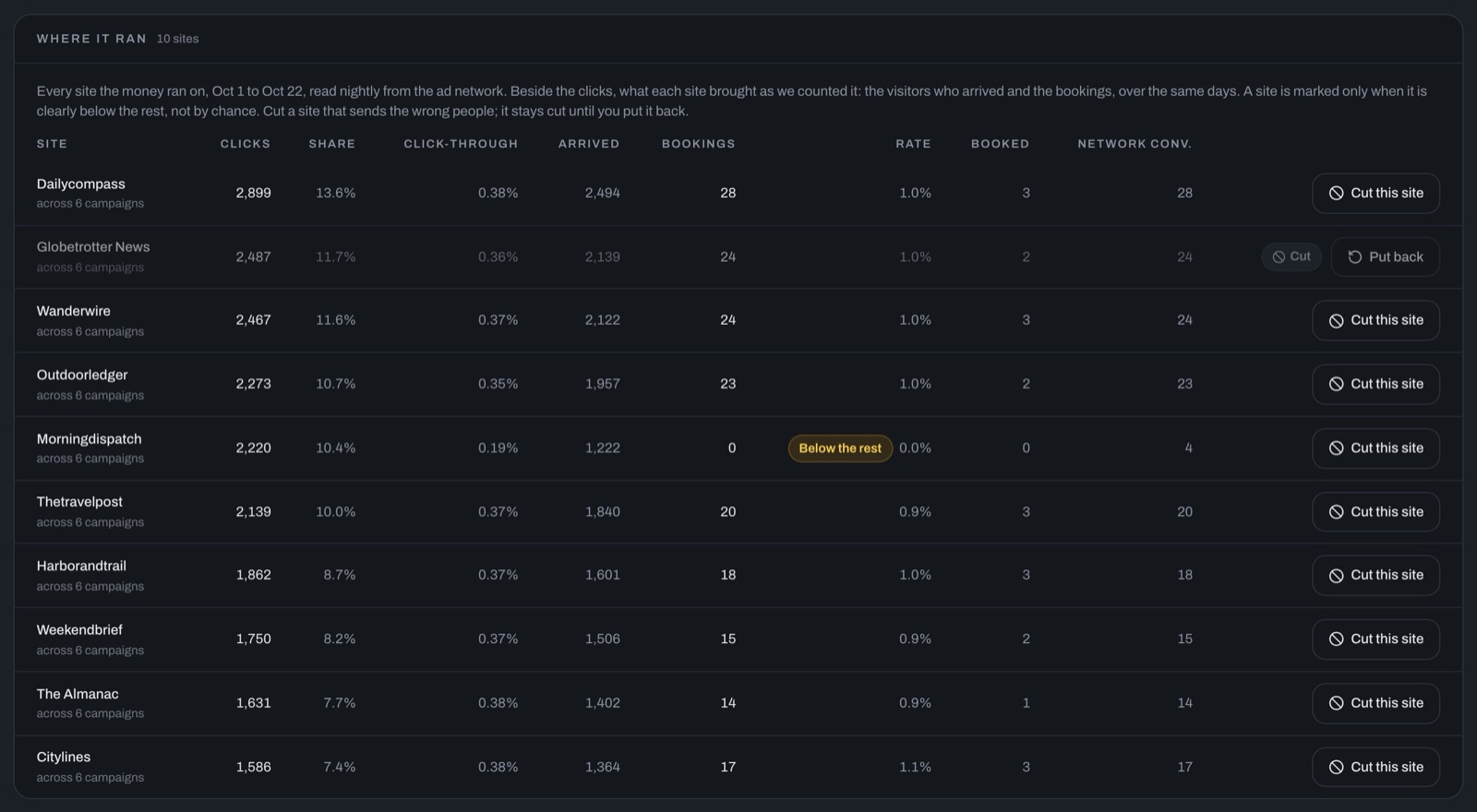
Below: a side-by-side table of what each costs per booking and who keeps the guest, then a three-question test for which to fund first. The portal demo shows how a native advertising booking is traced to the site and ad that sent it. It uses made-up brands and sample numbers.
Sponsored listings: you pay per click, then commission on the stay
An OTA sponsored listing is a paid spot near the top of the OTA's own search results. You pay for each click, and the booking still happens on the OTA.
Booking Holdings Sponsored Listings is one example. One campaign covers Booking.com, Priceline and Agoda, labeled "Ad" or "Promoted" (Koddi help center, 30 Jul 2026). It runs as a second-price auction: bid $1.75 against a next-best $1.40 and you pay $1.41. The sign-up page says bids start from $0.50 per click (Booking Holdings Sponsored Listings, undated).
Expedia TravelAds works the same way. You set a daily budget and a maximum cost per click, and ads show only when you have rooms free (Expedia Group Media Solutions, undated, 2022 data). Its sister product, Accelerator, is paid per stay instead. You choose an extra margin of 1–25% on top.
ROAS on an OTA report leaves out commission
The OTA's own report measures ROAS, return on ad spend: booking revenue divided by ad spend. A ROAS goal of 10 means $10 of booking revenue for every $1 of ads (Koddi help center, 2 Jul 2026).
That figure ignores the commission. At ROAS 10, the ads cost 10% of the booking's value. Add a 15% commission and the booking has cost you 25% of its value, before any Genius or program discount. Lighthouse makes the same point another way. On a $100 room rate, a $5 click adds 5% to a channel that already costs more (Lighthouse, 10 Sep 2025).
Native advertising: you pay per click, and the booking is direct
Native advertising puts your offer among the stories on news, travel and lifestyle sites. The reader clicks through to an advertorial page, an article-style page about your hotel, then books on your own site.
There is no commission on that booking. Your cost per booking is your click spend divided by the direct bookings it brought, plus your own booking-engine and card fees.
Direct bookings also tend to be bigger. In SiteMinder's 2025 data, bookings on hotel websites averaged US$516, against US$312 for OTAs (SiteMinder Hotel Booking Trends, 2025 data). SiteMinder puts this down to higher-value rooms, longer stays and extras. It is an average across many hotels, so it does not prove the same guest spends more with you direct.
On Itinex, campaigns for bookings run on the Managed plan, where an account manager builds the page and tests it. Every starting price is on the pricing page.
Side by side: cost per booking and who keeps the guest
| OTA sponsored listings | Native advertising | |
|---|---|---|
| You pay | Per click, in an auction | Per click |
| Commission on the booking | Yes, at your contract rate | None |
| Cost per booking | Ad spend ÷ bookings, plus commission | Ad spend ÷ direct bookings, plus your engine fees |
| Where they book | On the OTA | On your own site |
| Guest email you receive | An OTA alias | Their own address |
| Who can market to them next | The OTA | You, within the marketing rules |
| Who sees the ad | People searching your destination on the OTA | Readers on news, travel and lifestyle sites |
| Planning stage | Comparing hotels, ready to book | Earlier: the trip is taking shape |
| Results judged in | Days | Weeks: a full booking window |
| Main risk | Paying twice for one guest | Fewer bookings per click |
Give a native advertising test at least one full booking window for the season you are selling before you judge its cost per booking. Readers who were still planning when they clicked book weeks later, so an early verdict counts the clicks and misses the bookings.
Worked example: the break-even sum
This is an example to show the sum, not a benchmark. Use your own numbers from your OTA report and contract.
- A two-night stay sells for $300.
- Your commission is 18%: $54 a booking.
- You spend $500 on sponsored listings and the OTA reports 10 bookings: $50 of ads per booking.
- Each sponsored booking cost you $104, and the guest's email is an alias.
Now divide the same $500 by $104. Native advertising breaks even on cost at about five direct bookings from that spend. With five or more, each direct booking cost less than a sponsored one, and each came with a guest you can email.
If it brings fewer than five, the sponsored listing was cheaper for that period. Weigh that against what the guest's contact is worth to you (question 2 below).
Who keeps the guest: an alias or your own CRM
Booking.com does not pass on a guest's private email address. You see an anonymous alias ending in @guest.booking.com. It asks you to keep talking to guests through its own extranet and app (Booking.com partner help, undated). A sponsored listing does not change that. You paid for the click, but the OTA holds the relationship.
A native advertising booking lands in your own booking engine and CRM, the system where you keep guest records. Whether you can market to that guest later depends on the marketing rules and on what your own booking flow asks for. The rules are below.
Itinex keeps no lead database: the requests a page takes go to your own CRM. Your own retargeting pixels from Meta, Google Ads, LinkedIn or TikTok can ride on the ads and on the page, with consent where required. The audiences build in your own ad accounts, and we keep none of it.
Email and pixels: the UK and US rules
UK: you normally need consent to send marketing email to individuals. The exception, the "soft opt-in", applies only if you got their details from them while selling to them, and you market only similar products. You must also offer an opt-out when you collect the details, in your booking flow, and in every later message (ICO, opened 26 Oct 2026).
US: the CAN-SPAM Act covers all commercial email, not just bulk email. Each message must explain how to opt out, and opt-outs must be honored within 10 business days (FTC, Aug 2023).
Pixels: in the UK, the data regulator (the ICO) says the cookie rules also cover tracking pixels (ICO, opened 26 Oct 2026). Using them for online advertising needs consent (ICO, opened 26 Oct 2026). In California, readers can ask businesses to stop sharing their personal information for ads targeted across websites. Covered businesses must treat a browser's Global Privacy Control setting as that request (California Attorney General, updated 28 Aug 2026).
Three questions: which to fund first
Answer each one honestly. If two or three point the same way, fund that one first.
- When are the dates you need to fill? Within the next few weeks: sponsored listings first, because those guests are already searching with dates. A season or more away: native advertising first, because it reaches people while the trip is still being planned.
- Can you reach a past guest again, and do they rebook direct? Do you run guest emails, and do repeat stays come to your own site? Then owning the contact is worth more than one booking: native advertising. If you have no way to reach past guests, that advantage shrinks: sponsored listings.
- Can your own site take the booking at the same or a better total price? If yes, native advertising can work. If your booking engine is slow or your rate is higher than the OTA's, fix that first. Before your own price goes below the OTA's, check your contract (see rate parity below). Paid clicks to a weak booking page waste money on either channel.
The test picks the first budget, not the only one. A hotel can run sponsored listings for a gap three weeks out and native advertising for next season at the same time.
The two answers can point different ways for the same hotel. A midweek gap three weeks out is a job for sponsored listings, because those guests are already searching with dates. Next summer's rooms are a job for native advertising, started now.
Rate parity: check your OTA contract first
Some OTA contracts have rate parity terms, which bar a lower price elsewhere, such as on your own site. Read yours before your direct price goes below the OTA's. If a term is unclear, ask a lawyer.
UK: a "wide" parity term also covers other booking sites. Competition rules treat it as a "hardcore" restriction, so the contract loses its automatic exemption from competition law. A "narrow" term covers only your own site. It can keep the exemption if both sides' market shares are 30% or less (CMA, 20 Jul 2022).
US: we found no federal rule that bans these terms. The EU has gone further: its Digital Markets Act bans Booking.com's parity terms for properties in the EEA (European Commission, 28 Sep 2026).
Limits: where each one falls short
- Native advertising: fewer bookings per click. A reader on a news site is earlier in planning than someone comparing hotels on an OTA. Judge it on direct bookings over a full booking window, not on day-one clicks.
- Native advertising: more of the work is yours. You need a page between the ad and your site. You also run the booking engine, payments and guest service. If those are weak, the clicks will not turn into stays.
- Sponsored listings: costs climb in busy markets. Lighthouse notes clicks above $5 in some competitive markets (Lighthouse, 10 Sep 2025). Each one is paid on top of commission, and the results sit in the OTA's report, not yours.
Before any paid traffic, make a test booking on a phone, from the page the ad opens to the confirmation email, and time it. If it is slow, or the total price changes on the way, fix that first.
UK and US: the channel mix and the price rules
US: Expedia Group was the top revenue channel for US hotels in SiteMinder's 2025 data, its first time leading there since 2021. Hotel websites ranked third (SiteMinder Hotel Booking Trends, 2025 data).
Since 12 May 2025, the FTC's rule on unfair or deceptive fees has covered hotels and other short-term lodging. Any ad or offer that shows a price must show the total price clearly, and more prominently than any other price (eCFR, 22 Oct 2026). The total must include mandatory fees, such as a resort fee. Taxes and other government charges can be left out, but must be shown before the guest is asked to pay (FTC, May 2025). State laws that protect guests more still apply.
UK: Booking.com was the top revenue channel for UK hotels in SiteMinder's 2025 data. Expedia Group was second and hotel websites third (SiteMinder Hotel Booking Trends, 2025 data).
Since 6 April 2025, the DMCC Act requires an "invitation to purchase" to show the total price. That includes any fees, taxes or charges the guest must pay (legislation.gov.uk). The CMA says that covers an online ad and a listing in a booking site's search results. Its list of charges to include names VAT, and local taxes and resort fees paid at the hotel (CMA, 18 Nov 2025). The CMA can now fine up to 10% of global turnover (legislation.gov.uk).
For both markets, what this means for you: on an OTA, the OTA displays the price, using the rates and fees you give it. In the US, the FTC says sellers on an online marketplace must give it accurate pricing (FTC, May 2025). In the UK, the CMA says both the marketplace and the seller may be held responsible (CMA, 18 Nov 2025). In a native ad or on an advertorial page that names a price, the total price is yours to get right.
Sources
- Booking.com commission rates for hotels in 2026 — Tribii, 20 Jul 2026 Checked 23 Oct 2026.
- What is Booking Holdings Sponsored Listings — Koddi Help Center, 30 Jul 2026 Checked 23 Oct 2026.
- Booking Holdings Sponsored Listings (sign-up page) — Booking Holdings / Koddi, undated Checked 23 Oct 2026.
- How to choose the right ROAS Goal — Koddi Help Center, 2 Jul 2026 Checked 23 Oct 2026.
- TravelAds and Accelerator: Powerful hotel visibility boosters — Expedia Group Media Solutions, undated (cites 2022 data) Checked 23 Oct 2026.
- Guide to OTA sponsored listings — Lighthouse, 10 Sep 2025 Checked 23 Oct 2026.
- Hotel Booking Trends (2025 data) — SiteMinder, 2026 Checked 23 Oct 2026.
- Contacting guests (guest email alias) — Booking.com Partner Help, undated Checked 23 Oct 2026.
- 16 CFR Part 464, Rule on Unfair or Deceptive Fees — eCFR (Office of the Federal Register), up to date as of 22 Oct 2026; Part 464 unchanged since 12 May 2025 Checked 26 Oct 2026.
- The Rule on Unfair or Deceptive Fees: Frequently Asked Questions — Federal Trade Commission, May 2025 Checked 26 Oct 2026.
- Digital Markets, Competition and Consumers Act 2024, section 230 (omission of material information from invitation to purchase) — legislation.gov.uk, in force 6 Apr 2025 Checked 26 Oct 2026.
- Digital Markets, Competition and Consumers Act 2024, section 182 (final infringement notice and penalty) — legislation.gov.uk, in force 6 Apr 2025 Checked 26 Oct 2026.
- Price transparency (CMA209) — Competition and Markets Authority, 18 Nov 2025, page updated 7 Jan 2026 Checked 26 Oct 2026.
- How do we comply with the PECR electronic mail marketing rules? — Information Commissioner's Office, undated Checked 26 Oct 2026.
- CAN-SPAM Act: A Compliance Guide for Business — Federal Trade Commission, Aug 2023, edited Jan 2024 Checked 26 Oct 2026.
- What are storage and access technologies? — Information Commissioner's Office, undated Checked 26 Oct 2026.
- How do the rules apply to online advertising? (storage and access technologies) — Information Commissioner's Office, undated Checked 26 Oct 2026.
- California Consumer Privacy Act (CCPA) — State of California Department of Justice, Office of the Attorney General, updated 28 Aug 2026 Checked 26 Oct 2026.
- Vertical agreements block exemption order (VABEO) guidance, CMA166 — Competition and Markets Authority, 20 Jul 2022 (guidance dated 12 Jul 2022) Checked 26 Oct 2026.
- Factsheet: How the DMA ensures businesses using Booking.com are free to set their prices on and off Booking.com — European Commission, 28 Sep 2026 Checked 26 Oct 2026.
How we made this: written with AI from the sources above, each opened before it was cited, and read and approved by Russell Goodall. Our editorial standards