Tourist board co-op advertising: a five-step partner plan
A five-step co-op advertising plan for tourist boards, with a seven-point partner report checklist and the cost-per-referral sum to agree first.
Russell Goodall, Founder Published 9 min read
The short answer
Run co-op advertising as a published program, the way US state offices do: Utah's 2026 grant requires a 1:1 exact cash match (Utah Governor's Office of Economic Opportunity, 2026). Our five-step co-op plan below turns that into a routine, ending with a report each partner gets.
Set who can join and what you match, and sell a few fixed packages. Send every ad to a page you can measure. Then give each partner its own report, built from our seven-point partner report checklist and one agreed cost-per-referral sum.
Matches vary by program. Missouri's FY26 program reimburses up to 50% of a DMO's approved media project (Missouri Division of Tourism, March 2025).
The checklist is in Step 5, ready to copy. To see a per-partner report first, open the Itinex portal demo. It uses made-up brands and sample numbers, and asks for a name and a company email.
Co-op advertising: one campaign, shared cost
Co-op advertising means the board and its partners pay into the same campaign. The board brings the destination brand, the media buying and often part of the money. Partners such as hotels, attractions and tour companies bring an offer and their share.
For partners, the pitch is simple. Travel Texas lists what its co-op gives them: discounted rates, vetted media, expert guidance, clear reporting and one contract. Partners also keep control of their own campaigns (Travel Texas, Office of the Texas Governor, checked Oct 2026).
Most programs also set limits. Explore Minnesota allows one package per participant and requires its logo on every co-op ad. Its streaming TV packages cost partners $1,000 to $4,000, with listed savings of 75% (Explore Minnesota, undated program page, checked Oct 2026).
UK and US: who pays, and how partners join
US. State tourism offices and local DMOs (destination marketing organizations, also called CVBs) often match a partner's money. Visit Williamsburg matches partner media spend dollar for dollar between $1,000 and $25,000. It is open only to tourism businesses located in Williamsburg, James City County or York County (Visit Williamsburg, undated program page, checked Oct 2026).
Arizona's state program is built for rural DMOs, regional partnerships, statewide tourism associations and tribal entities (Arizona Office of Tourism, undated).
UK. Destination bodies more often work through membership and partner packages. Visit Exmoor's packages start at £50. Every visitor business in its area can join its area campaigns, and paying members get discounted advertising rates (Visit Exmoor, updated Feb 2026).
In England, VisitEngland's Local Visitor Economy Partnerships (LVEPs, the accredited lead destination bodies) "lead, market and manage" their areas. One of the scheme's goals is more income generation and more varied funding (VisitEngland, updated Sep 2026). Nationally, VisitBritain asks would-be campaign partners to register on its eSourcing platform to respond to opportunities. Its page also says it will match a partner's investment in some cases. That offer sits under a purchasing system the same page says closed on 10 September 2025 (VisitBritain, updated Jul 2026).
Partner money matters more when core budgets are under pressure. Destinations International's 2025 DestinationNEXT study found 42% of destination organizations fear budget cuts or elimination. That is up from 37% in 2023, as reported by CMW (July 2025).
| US | UK | |
|---|---|---|
| Who runs it | State office or local DMO/CVB | Destination body or LVEP |
| How partners join | Application or signed order | Membership or partner package |
| Board's share | Often a set match (1:1, up to 50%) | Discounted member rates |
| Common rules | Location, logo, approvals, proof | Membership tier, campaign terms |
The five-step co-op plan
- Partners: publish who can join and what you match.
- Packages: sell two or three fixed tiers.
- Pages and tracking: send every ad to a page you can count.
- Launch and checks: approve once, then check weekly.
- The partner report: each partner sees its own results, and only those.
Step 1, partners: publish who can join and what you match
Write the rules down before you invite anyone. Partners compare notes, so the rules must survive a hard question at a members' meeting.
Your rules page should answer four things:
- Who is eligible: location and business type, as Visit Williamsburg does.
- The match: the ratio, the smallest and largest amount, and the total pool.
- How slots are given out: South Dakota reserves each 2026 program first come, first served (South Dakota Department of Tourism, checked Oct 2026).
- How many packages each partner may take: one each is the simplest rule.
First come, first served is easy to run. It also favors larger partners with staff who watch for the email. If small businesses matter to your board, hold back some slots for them, or give out slots by theme or season.
If public money pays for the match, the funder's own rules may also limit who can join. In the UK, a public body's grant or discount to a business can count as a subsidy under the Subsidy Control Act 2022. Small amounts, up to £315,000 per business over the current and previous two financial years, are exempt from most of those rules (Department for Business and Trade, August 2025).
Put a named offer in every co-op ad: the deal, its dates and its price, in the partner's own words. A general "stay with us" message gives a reader on a news site no reason to click now.
Step 2, packages: two or three fixed tiers, priced in writing
Fixed tiers save a small team from custom deals. Each package sheet should state:
- the price to the partner and the board's share
- the dates, the markets and the media
- what the partner sends (offer, images, link) and by when
- the co-branding rule (whose logo goes where)
- the report the partner gets, and when
A worked example (an example, not a benchmark): the board sets a match pool of $20,000 at 1:1, capped at $2,500 per partner. Eight partners at the cap use the whole pool, so the campaign has $40,000 of media. A partner who pays $2,500 gets $5,000 working for it.
Its cost per referral is then $5,000 divided by the referrals its report shows. Agree on that sum with partners before launch, so nobody argues about it afterwards.
Step 3, pages and tracking: send every ad to a page you can count
Decide where each ad lands. A partner's own page is simple, but you see little of what happens there. A page on your site that features the partner, or a themed page with several partners, keeps the visitor inside your brand first.
Then agree what you count. A partner referral is a click from your page through to the partner's own site. It shows what the board sent, and you can count it the same way for every partner.
Native advertising places ads among the stories on news and travel sites (the basics are here). If your co-op uses it, the page between the ad and the partner matters more. Readers arrive mid-article, not mid-search, so the page has to give them a reason to click on.
Counting referrals needs a tracking tag on your page. The rules on tags differ by market, so check your cookie notice and consent setup against both before launch.
UK. The Information Commissioner's Office (ICO), the UK data regulator, says tags used for online advertising, including measuring it, need the visitor's consent (ICO, April 2026). Analytics used only to count how your own site is used, to improve it, can run without consent. Narrow conditions apply, including clear information and a "simple and free" means to object. This exception does not cover advertising (ICO, April 2026).
US. California lets people opt out of the sale or sharing of their personal information. Covered businesses must honor a browser's Global Privacy Control signal as that opt-out. The law covers for-profit businesses that meet set size or data thresholds (California Attorney General, August 2026). Colorado has required the same since July 2024, for businesses within its privacy law's thresholds (Colorado Attorney General, January 2025).
A strong co-op page puts each partner's offer in one place, with the price and dates the partner already publishes. Every reader then finds one that fits. We would test that list first, then a short story built on one partner's offer against it, and let the referral counts pick the winner.
Step 4, launch and checks: approve once, then check weekly
Approvals take longer than most partners expect. Missouri allows up to five business days to approve each final ad (Missouri Division of Tourism, March 2025). Visit Williamsburg's published steps make a useful model timeline:
| When | What happens |
|---|---|
| 30 to 45 days before launch | Signed order due |
| 3 weeks before launch | Partner's creative due |
| Launch | Board handles setup |
| 4 to 6 weeks after the end | Campaign report sent |
Source: Visit Williamsburg, checked Oct 2026.
Once ads are running, check where they appear each week. If state co-op money is in the mix, read its rules on placement. Missouri's guide sets a rule for ad networks and private marketplaces. Placement should be transparent, meaning the advertiser knows the exact websites and placements (Missouri Division of Tourism, March 2026).
Co-op ads carry the board's brand and a partner's offer, so agree who the advertiser is. In both markets, the rules say readers must be able to tell that each one is an ad.
In the UK, the CAP Code, which the ASA enforces, says ads "must be obviously identifiable as such". Marketers and publishers must make clear that advertorials are ads, "for example, by heading them 'advertisement feature'" (CAP Code, section 2, checked Oct 2026). Since 6 April 2025, UK consumer law has treated paid editorial content that doesn't make the payment clear as unfair in every case (legislation.gov.uk, in force April 2025).
In the US, the FTC's guide says an ad "shouldn't suggest or imply to consumers that it's anything other than an ad". It says readers are likely to understand labels such as "Ad", "Advertisement" and "Sponsored Advertising Content". It calls "Promoted" "at best ambiguous". A logo or brand name on its own is not likely enough, and the label belongs in front of or above the headline (FTC, December 2015).
Step 5, the partner report: each partner sees its own results, and only those
The report is what brings a partner back next year. A partner who sees results while the campaign runs can still fix a weak offer. No partner should ever see another partner's numbers.
Our seven-point partner report checklist:
- What ran: dates, ads, markets, and every site the ads appeared on
- Money: the partner's share, the board's share, and what was spent
- Delivery: clicks and the visitors who arrived on the page
- Referrals: clicks through to the partner's own site
- Cost per referral: total media divided by referrals, as agreed in Step 2
- Changes: sites or ads cut during the campaign, and why
- Next time: one thing to keep and one thing to change
The board needs a one-page summary on top: referrals by partner, the match used against the pool, and totals for the month or quarter.
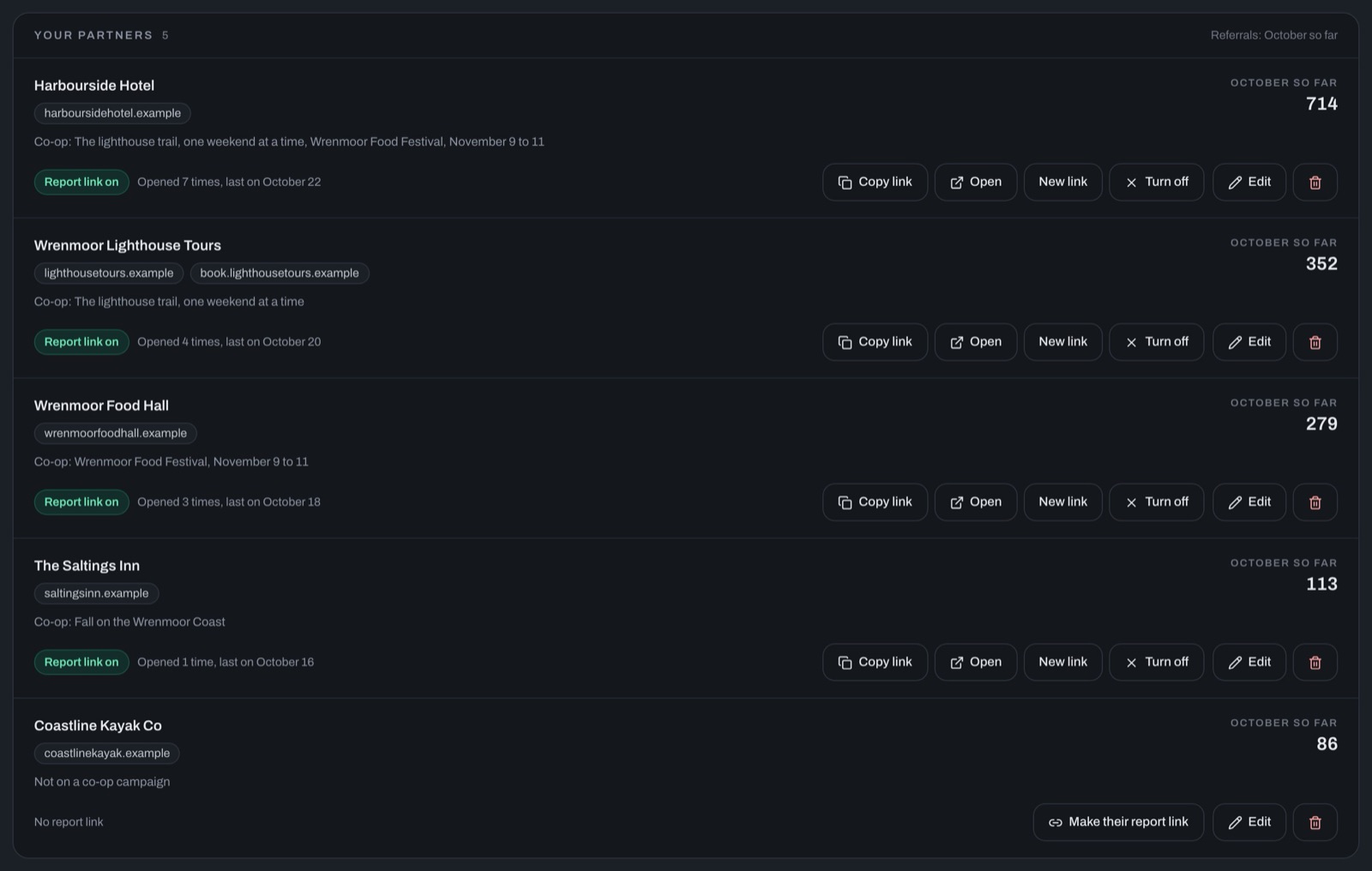
If your board takes state co-op money, your partner reports also feed its paperwork. Missouri requires a Project Summary Report from every DMO in its program. It asks for a written explanation if less than 85% of the awarded funds are used (Missouri Division of Tourism, March 2026).
Expect each partner to look first for its own referrals beside what it paid in. Put that line at the top of every partner's report, with the proof of where the ads ran just under it.
Limits: three things co-op advertising will not fix
- Small slices are hard to judge. A $1,000 package may bring too few referrals to tell a good offer from a weak one. Group small partners into one themed campaign, and report the theme as well as each partner.
- Referrals are not bookings. A referral proves the board sent a visitor, not that they booked. Ask partners for a booking count or a co-op offer code if your board wants more.
- The paperwork grows with every partner. Missouri requires proof of expense, proof of payment and proof of performance for every item it reimburses (Missouri Division of Tourism, March 2026). Keep tiers few and use one report template for everyone.
Sources
- Tourism Cooperative Marketing Grant, 2026 cycle — Utah Governor's Office of Economic Opportunity, 2026 Checked 23 Oct 2026.
- FY26 Cooperative Marketing Program & Reports Guide — Missouri Division of Tourism, March 2025 Checked 23 Oct 2026.
- Advertising Co-Op Opportunities — Travel Texas, Office of the Texas Governor, undated (FY27 enrollment notice) Checked 23 Oct 2026.
- Co-op Marketing — Explore Minnesota, undated Checked 23 Oct 2026.
- Co-Op Marketing Program — Visit Williamsburg, undated Checked 23 Oct 2026.
- Cooperative Marketing Program — Arizona Office of Tourism, undated Checked 23 Oct 2026.
- Join Us as a member of Visit Exmoor — Visit Exmoor, updated 27 Feb 2026 Checked 23 Oct 2026.
- Local Visitor Economy Partnership (LVEP) Programme — VisitEngland, updated 15 Sep 2026 Checked 23 Oct 2026.
- Register for commercial partnership opportunities with us — VisitBritain, updated 14 Jul 2026 Checked 23 Oct 2026.
- DMO funding is at risk – why? — CMW (Conference & Meetings World), 14 Jul 2025 Checked 23 Oct 2026.
- Co-op programs — South Dakota Department of Tourism, undated (2026 booklet) Checked 23 Oct 2026.
- FY27 Cooperative Marketing Program & Reports Guide — Missouri Division of Tourism, March 2026 (file posted Sep 2026) Checked 23 Oct 2026.
- UK Subsidy Control Regime: statutory guidance — Department for Business and Trade, updated 4 Aug 2025 Checked 23 Oct 2026.
- How do the rules apply to online advertising? — Information Commissioner's Office, guidance last updated 29 Apr 2026 Checked 23 Oct 2026.
- What are the exceptions? — Information Commissioner's Office, guidance last updated 29 Apr 2026 Checked 23 Oct 2026.
- California Consumer Privacy Act (CCPA) — State of California Department of Justice, updated 28 Aug 2026 Checked 23 Oct 2026.
- Universal Opt-Out and the Colorado Privacy Act — Colorado Attorney General, updated 31 Jan 2025 Checked 23 Oct 2026.
- 02 Recognition of marketing communications (CAP Code) — ASA and CAP, undated Checked 23 Oct 2026.
- Digital Markets, Competition and Consumers Act 2024, Schedule 20 — legislation.gov.uk, paragraph 12 in force 6 Apr 2025 Checked 23 Oct 2026.
- Native Advertising: A Guide for Businesses — Federal Trade Commission, Dec 2015 Checked 23 Oct 2026.
How we made this: written with AI from the sources above, each opened before it was cited, and read and approved by Russell Goodall. Our editorial standards