What makes travel native advertising work: 34 case studies
34 travel native advertising case studies credit the path after the click. What worked, and our eight-question checklist.
Russell Goodall, Founder Published 9 min read
The short answer
We read 34 travel native advertising case studies. In our reading, every one that describes what happened after the click credits a step there. It was a story before the offer, a page that kept the ad's promise, or follow-up for readers who left.
The one case that tested the page found a 35% higher rate of completed sign-ups, on the same channel (Outbrain, 2018). Our checklist at the end turns the cases into eight questions to ask before you spend.
The cases come from native advertising networks and travel ad platforms, published between 2015 and 2026. Their results are the sellers' own figures.
Same channel, better page: a 35% higher sign-up rate
Booking.com wanted property owners to list homes and apartments. At first it sent native readers to "landing pages built for Paid Search". Many entered an email address, then "got stuck at this first step", the case says (Outbrain, 2018).
The fix was the page, not more traffic. The network's team wrote three versions of the page copy. It added proof points: customer testimonials, awards, and an estimate of weekly earnings based on where the visitor was.
A two-week internal A/B test compared the pages. The rate of completed registrations rose 35%, and the rate of people reaching a quarter of the sign-up rose 14%. The case gives no baselines or volumes.
What it means: native readers respond when the page is built for readers. A page built for searchers assumes they already want the thing. A reader needs a reason first, and the page can give it.
Four paths that worked
The cases that describe the click's destination follow one of four paths.
| Path after the click | Cases | What the cases report |
|---|---|---|
| A story first, then the offer | Barceló Hotel Group (2023), TUI's Passenger 6A (2017), Secret Escapes (2015) | Twice the click rate of promotional ads; 96 bookings from one campaign's readers; sign-ups "31% more valuable" |
| A destination page that hands readers to partners | Austria Tourism (2017), Visit Armagh (2025 write-up) | Readers passed on to the hotels and businesses that take the booking |
| The brand's own site, then retargeting | Greek National Tourism Organization (2023), Transavia (undated) | A lower bounce rate; a cost per acquisition below other channels |
| Bookings sent back to the network's bidding | Minor Hotels (2026 PDF) | 5x return on ad spend |
Retargeting means showing ads again to people who already visited. Automated bidding means the network sets the price of each click, aiming at the results you feed it.
Story first: readers who read went on to book
Barceló Hotel Group linked each ad to its own article in the brand's "Pin and Travel" online magazine. Readers got travel advice, then could go on to the hotels to book (Taboola, Aug 2023).
The case reports a click-through rate 2x that of Barceló's promotional ads. It also reports a cost per new qualified user 91% lower in Spain and 75% lower in the UK. The client's own summary: readers were "first attracted with interesting content and then redirected to an e-commerce experience."
TUI's Passenger 6A, its editorial brand, ran a "Visit Britain" campaign in India. It gives the only step-by-step travel funnel we found (Taboola, 2017):
- 249,820 visits to articles
- 4,329 of those readers went on to pages with TUI packages
- 96 bookings and 600 nights
That is 1.73% from article to package page, and 2.22% from package page to booking, by our arithmetic. It also shows where the gains are: every extra reader who reaches the offer is another chance of a booking.
Secret Escapes linked each article to a sign-up page (Taboola, 2015). As of October 2015, its UK sign-ups from the network were "31% more valuable" than those from display ads. The reason given: they "were more likely to book travel within their first month".
Why a story needs a page that carries it on
A 2024 study in the Journal of the Academy of Marketing Science helps explain the story-first path (LaBrecque et al., Nov 2024). Native ads drew the most clicks when they sat in the feed and sold the least. But readers sent from the feed to an advertiser's site left more often. In a lab study, readers sent that way felt more annoyed and more ready to leave.
What it means: the ads that earn the clicks read like stories. The page they open should carry the story on, then make the offer.
Retargeting brought visitors back
The Greek National Tourism Organization sent its ads to VisitGreece.gr, "the GNTO homepage". Its agency then suggested retargeting "to lower the bounce rate of website visitors". The pixel found visitors who had engaged, and ads followed them. Bounce rate fell 11.5% (Taboola, 2023).
Transavia, the low-cost airline, ran the same idea in two steps. Travel advice pages built "an affinity audience pool". That pool then saw "commercial offers linked to the pages they visited". The case reports a cost per acquisition 20% below Transavia's other channels (Outbrain, undated).
What it means: a reader who leaves isn't lost. Following up is part of the path, not an extra.
Matching the ad to the page, then feeding bookings back
Minor Hotels shows the newest version of the path, for its Anantara resorts in Thailand (Realize, PDF dated Jun 2026).
Its ads said "Experience the world", and the landing page carried the line on with "Follow your own path". That is message match: the page keeps the ad's promise. Then the pixel "collected booking confirmation data" so the network's automated bidding could aim at return on ad spend. The case reports 5x return on ad spend.
What it means: the ad, the page and the bidding worked together. Each step had a job.
Two lessons from campaigns that fell short
Sellers publish wins, so shortfalls are rare in public. The two we found point at steps after the click:
- Count the bookings you can't see. Most Club Med guests book by phone, so it judged ads on steps it could see on its site. Its cost per first booking step had risen "seven-fold" across all its channels, and "native advertising didn't perform as expected". Retargeting was still a plan (Microsoft Advertising, 16 May 2023).
- Build awareness before you ask. Visit Armagh's first wave showed the place "needed to increase brand awareness". The second wave moved money into video (DTTT, 19 Feb 2025).
Club Med's story gives no reason for the native shortfall. It is one brand's view, published by an ad seller.
Speed to lead: where the lead is won
Speed to lead is how fast a request gets a reply. No case study measures it, but the evidence says it decides a lot.
A 2011 study in Harvard Business Review looked at 1.25 million sales leads at 42 US firms (HBR, Mar 2011). Firms that tried to reply within an hour were "nearly seven times as likely to qualify the lead". The comparison was with firms that tried "even an hour later".
The same authors tested 2,241 US companies, and 23% "never responded at all" (figures quoted by SmartCompany, 1 Jul 2011). The data is old and not from travel, and "qualify" is not "book".
Travel has its own number. In September 2022, CM.com sent questions to 25 of the UK's top tour operators, ranked by ATOL passenger numbers. It used channels from email and phone to WhatsApp and live chat, and 48% of the questions got no answer (CM.com, 20 Oct 2022). These were customer questions, not sales leads, and CM.com sells customer messaging software.
The form matters too. Across 4.8 million sessions on inquiry forms, 42.7% were completed: 37.7% on phones against 47.7% on desktops (Zuko, undated). Zuko sells form analytics.
What it means: a quick reply and a short form keep the readers the ad and the page worked to win.
The networks' own advice: clicks are the start
The networks tell their own advertisers the same thing. One network's help center warns that more clicks "won't help unless the clicks are working for you". It adds that titles and thumbnails "should speak to the experience the user will have on your landing page" (Realize Help, updated 21 Jul 2025).
Another lists five "conversion killers" for native campaigns (MGID, 4 Oct 2021):
- No cohesive story from the ad through the page
- An offer that doesn't fit the reader's stage
- Switching offers, markets or sales tactics
- Slow pages, and call centers that can't cope with the volume
- No retargeting
On speed, MGID asks for the first screen in under one second. Google's own line for a "good" main-content load is 2.5 seconds (web.dev, updated 31 Oct 2024).
Our checklist: eight questions about the steps after the click
Ask these of any campaign, run by anyone, before the budget goes up. Each row ties a step to what the cases show.
| Step | What the cases show | Ask before you spend |
|---|---|---|
| The ad | The page should keep the ad's promise (Minor Hotels) | Does each ad say what its page says? |
| The page | A page built for readers lifted the sign-up rate 35% (Booking.com) | Is this page built for a reader or a searcher? |
| Speed | Google's "good" line is 2.5 seconds | How fast does it load on a phone, on mobile data? |
| The first ask | Readers are early, so a small ask comes first | What is the first thing we ask for? |
| The form | Under 38% of inquiry-form sessions on phones end in a send | How many fields, and who tested it on a phone? |
| The reply | Replying within an hour made a lead far likelier to qualify (HBR, 2011) | Who answers a request, and how fast? |
| The follow-up | Retargeting brought a tourist board's visitors back (Greek tourism board) | Who sees the offer again, and with what message? |
| The count | Sign-ups were judged by what they booked later (Secret Escapes) | Can a booking weeks later be traced to its page, site and ad? |
A small first ask could be a brochure, an inquiry, a deal alert or a click through to a partner. We would start with the reply row. It costs nothing to fix, and it's the step that keeps the leads you've paid for.
How to read these cases
- They are the sellers' own figures. Wins get published, and baselines are rarely given. Read them for what was tried, and test it on your own campaign.
- The most detailed ones are older. The A/B test, the step-by-step funnel and the booked-later sign-ups date from 2015 to 2018. The methods still apply; the numbers won't transfer as they are.
- Your own test is the best benchmark. Only Booking.com tested one page against another, and no public benchmark covers native landing pages. The largest landing-page report splits results by email, search and social traffic only (Unbounce). Two versions of a page on the same traffic tell you more than any average.
For where clicks drop away between the ad and the booking, see Why your ad clicks don't match your bookings. For page styles with examples, see Travel advertorials: what works.
Where Itinex fits
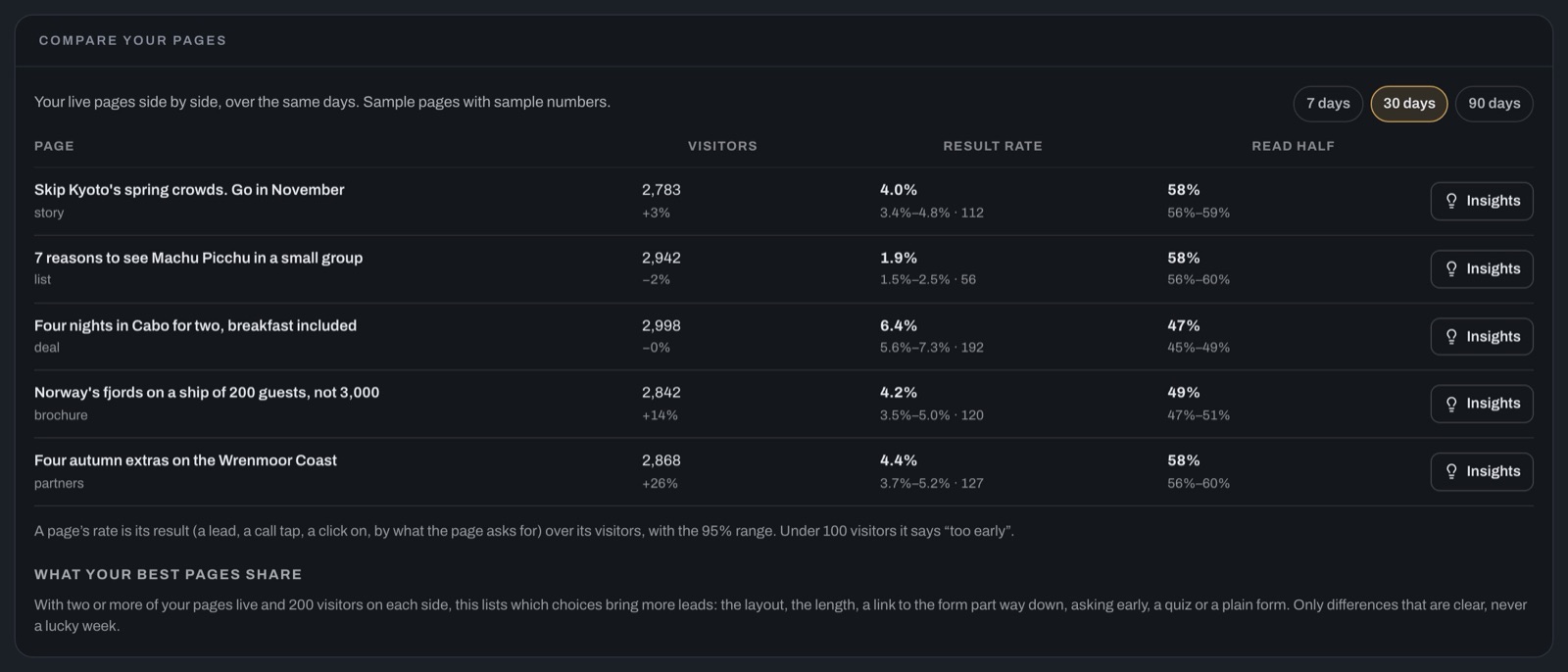
Itinex is a travel advertising platform with the reach of a global native advertising network. Its advertorial pages are written from the client's own website, as a story, a list, a deal, a brochure or a partner page. Every price, date and number on them is one the client already publishes. Two versions run on an even split, and the one that brings more is named once the difference is clear.
A request from a page goes straight to the client's CRM or inbox. It carries the page, the version, the site and the ad that brought it. We keep only its reference, never the person's details.
A booking is marked with one tap in the portal, or by the client's CRM with that reference, whenever it happens. For tourist boards, every partner referral is counted, and each partner gets its own report link.
How fast you reply stays the one step only you control.
Sources
- Booking.com Test Content Rich Landing Pages For Discovery — Outbrain, case study PDF, 2018 Checked 27 Oct 2026.
- Barceló Hotel Group & Jakala Iberia Achieve 91% Decrease in Cost Per New Qualified User — Taboola, case study PDF, 10 Aug 2023 Checked 27 Oct 2026.
- Passenger 6A Significantly Grows Audience with Taboola — Taboola, case study PDF, Sep 2017 Checked 27 Oct 2026.
- Secret Escapes' CTR Increases by 288%, Generating High-Quality Leads — Taboola, case study PDF, data as of Oct 2015 Checked 27 Oct 2026.
- Austria Tourism case study — Taboola, case study PDF, Nov 2017 Checked 27 Oct 2026.
- Visit Armagh uses Tourism Ireland's Partnership Programme to partner with Sojern on a co-op campaign — DTTT, 19 Feb 2025 Checked 27 Oct 2026.
- Visit Armagh — Sojern, customer success story, undated Checked 27 Oct 2026.
- The Greek National Tourism Organization and Project Agora — Taboola, case study, 2023 Checked 27 Oct 2026.
- Transavia: Discovery, an acquisition channel more profitable than search — Outbrain, case study, undated Checked 27 Oct 2026.
- Native advertising effectiveness: The role of congruence and consumer annoyance on clicks, bounces, and visits — LaBrecque, Voorhees, Khodakarami and Fombelle, Journal of the Academy of Marketing Science 52(6), Nov 2024 (abstract) Checked 27 Oct 2026.
- Minor Hotels Achieves 5x ROAS Promoting Anantara with Realize — Realize (Taboola), case study PDF dated 30 Jun 2026 Checked 27 Oct 2026.
- Club Med — Microsoft Advertising, customer story, 16 May 2023 Checked 27 Oct 2026.
- The Short Life of Online Sales Leads — Oldroyd, McElheran and Elkington, Harvard Business Review, Mar 2011 Checked 27 Oct 2026; the figures are behind HBR's paywall and were read in the SmartCompany quote below.
- Are you letting online leads go cold? — SmartCompany, 1 Jul 2011 Checked 27 Oct 2026.
- 48% of enquires to leading UK travel brands go unanswered — CM.com, 20 Oct 2022 (audit 5–8 Sep 2022) Checked 27 Oct 2026.
- Form type benchmarking — Zuko, undated Checked 27 Oct 2026.
- How to improve campaign performance — Realize Help Center (Taboola), updated 21 Jul 2025 Checked 27 Oct 2026.
- Top 5 conversion killers that haunt your native campaigns — MGID, 4 Oct 2021 Checked 27 Oct 2026.
- Web Vitals — web.dev (Google), updated 31 Oct 2024 Checked 27 Oct 2026.
- Travel & hospitality conversion rate benchmarks — Unbounce, undated Checked 27 Oct 2026.
- llms.txt — Itinex, live file; every Itinex product claim was checked against it Checked 27 Oct 2026.
How we made this: written with AI from the sources above, each opened before it was cited, and read and approved by Russell Goodall. Our editorial standards